Box 1.1 An Example Computation of Minimum Angle of Resolution (MAR)
Let us consider a visual acuity chart calibrated for 6 meters.
The height of the 6/6 or 20/20 optotype is 0.875 cm or ~0.00875 m
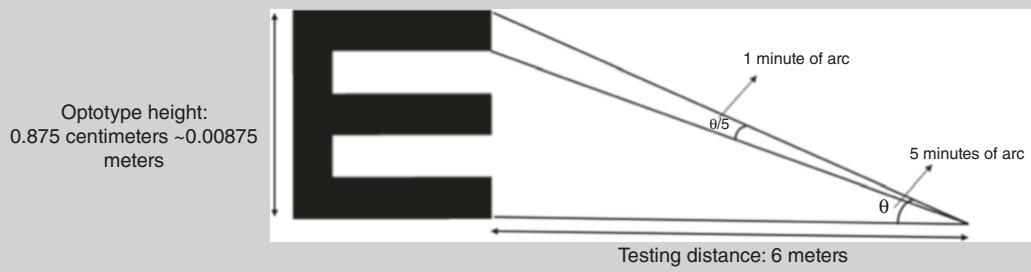
Tan θ = length of the opposite/length of the adjacent
\theta=\tan^{-1}\left(0.00875/6\right)=\tan^{-1}\left(0.00145\right)=0.083^{\circ}(degrees to minutes of arc, 1°=60′)
Therefore,0.083°×60′=4.98′-5′
Minimum angle of resolution (angle subtended by one stroke) = θ/5=5/5=1′ tation of how many photoreceptors can be packed into the fovea, along with neural and optical limi tations, the maximum resolution capacity of the eye is usually around 30 CPD. This spatial fre quency corresponds to a visual acuity of 20/20 (or 6/6). The math for this is shown in the calcu lation in Box 1.2 with a 20/40 optotype as an example. It must be noted that acuity better than 20/20 (or 6/6) is also possible depending on an individual's neural and optical factors. In the periphery, the packing of the photoreceptors is not dense, and the morphology of the cones in the periphery is wider than those in the foveal region. Also, more rods are interspersed in the periphery. All these contribute to poorer visual acuity in the periphery [24].
1.3.2 Near Visual Acuity
The resolution capacity of the eye remains the same for both distant and near objects. The only difference between distance and near vision is that the crystalline lens needs to accommodate for near vision. This is because light rays from a near source are divergent, unlike those from dis tant objects, for which parallel light rays reach the eye. Hence, to negate the diverging light rays, the lens increases the plus power by becom ing more biconvex, a process called accommo dation. In younger individuals, a good distance acuity should also be reflected as good near acu ity. If not, accommodative issues should be con sidered or ruled out. In individuals closer to their
Box 1.2: An Example Computation for Converting the Snellen Fraction to Cycles Per Degree and Cycles Per Degree to Snellen Fraction
Snellen fraction to cycles per degree
Let us consider a 6/12 or 20/40 optotype. In this, each stroke subtends 2 minutes of arc and therefore 1 cycle (black and white region) = 4 min of arc

Testing distance: 6 meters or 20 feet
as 1°=60′ (minutes of arc)
(1 cycle/4′) ×(60'/1°)=15 cycles per degree (CPD)
Therefore 20/40 = ~15 CPD
Cycles per degree to Snellen fraction
Let us consider the resolution acuity of 15 CPD. Since 15 cycles are in 1°, therefore one cycle’s angle of subtense is
(1 cycle/15 cycles/degree) ×(60′/1°)=4′
In 1 cycle, we have 4′ since there are 2 strokes in one cycle,
Minimum angle of resolution of one stroke = 4′/2 = 2′
Therefore, the Snellen denominator = 2′=x/20; x=40
Hence, 15 CPD ~20/40 fourth decade of life (40 years), decreased accommodative amplitude may cause a reduc tion in near acuity (presbyopia). An appropriate near addition will restore the near visual acuity in such patients. However, in some instances, children may also have accommodative disor ders, with or without good near visual acuity. These children may also require near addition [25, 26].
In other instances, where an accommodative disorder is not present, central opacity could be responsible for the reduction in near acuity. This is because of the pupillary miosis at near vision, and the effect of a central opacity, especially those closer to the nodal point (e.g., posterior polar cataract), could be more profound. Sometimes, binocular vision disorders like con vergence insufficiency could cause a disturbance in reading. In some instances, pupillary miosis can cause an increased depth of focus, and that could result in better near visual acuity, with min imal or no near addition, even in the presbyopic age-group (e.g., use of pilocarpine in older adults for glaucoma could result in good near visual acuity).
1.3.3 Contrast
Contrast sensitivity is closely related to real- world visual functioning. Individuals with reduced contrast sensitivity at middle-to-low spatial frequencies were found to have difficulty in day-to-day tasks such as face recognition, identifying road signs and objects placed in common places, e.g., on an office desk, etc. [27]. In a large retrospective study of 1000 patients visiting a low-vision clinic, close to 50% of them with better than 20/60 presenting distance visual acuity, reported difficulty in face recognition [28]. In another large prospective study (n = 1113) on individuals with different ocular conditions, such as age-related macular degeneration, cataract, glaucoma, and retinitis pigmentosa, the contrast sensitivity tests pro vided valuable information in addition to visual acuity tests in the early detection of the disease [29].
Contrast sensitivity and low-contrast acuity are two different terms; therefore, care should be taken not to use them interchangeably. As dis cussed earlier, only the CSF gives a complete picture of the individual’s contrast sensitivity across varying spatial frequencies; currently, CSF can be measured using tests such as the Functional Acuity Contrast Test (FACT) [30] and quick CSF [31].