COSMETIC EYELID AND PERIOCULAR SURGERY
Involutional changes
Involutional (age-related) changes around the eyes can lead to functional and cosmetic concerns that may require treatment.
Reduction in cutaneous elasticity and thickness results in loose, wrinkled skin.
Weakening of the orbital septum may lead to orbital fat prolapse.
Thinning and stretching of the canthal tendons, levator aponeurosis and lower lid retractors may cause eyelid laxity and ptosis.
Atrophy of orbital and eyebrow fat pads can give enophthalmos and eyebrow sagging.
Weakening of the frontalis muscle and epicranial aponeurosis may cause descent of the eyebrows and increasing looseness of upper eyelid skin.
Thinning and stretching of midfacial support leads to descent with formation of a tear trough depression and exacerbation of lower eyelid changes.
Thinning and resorption of periorbital bone exacerbates the appearance of surplus overlying tissues.
Non-surgical techniques
Botulinum toxin injection to periocular muscles
Botulinum toxin injection can be used to reduce wrinkling, particularly for ‘crows’ feet’ at the lateral canthus and for glabellar frown lines, and ‘brow lift’ by a reduction in the action of brow depressors. Complications include temporary ptosis, lagophthalmos, ectropion and diplopia.
Tissue fillers
These are used to address age-related wrinkles, and less commonly defects from other causes such as trauma. Complications include hypersensitivity reactions.
Hyaluronic acid is the most commonly used tissue filler, and can be used to temporarily fill in hollows and replace lost volume. They are injected deep to orbicularis and the effects generally last 3–12 months depending on the agent used.
Autologous fat gives a more permanent replacement.
Others include collagen, microspheres of calcium hydroxyapatite and synthetic fillers.
Skin resurfacing
Removal of the superficial layers of the skin, by chemical peels or laser, can lead to a reduction in wrinkling, increased evenness of pigmentation, removal of blemishes and improved texture by generating new epidermis and increasing collagen production in the dermis.
Surgical techniques
Upper eyelid blepharoplasty
Upper eyelid involutional changes are characterized by surplus upper eyelid skin (dermatochalasis) that leads to baggy lids with indistinct creases and pseudo- or mechanical ptosis. It may cause a heavy sensation around the eyes, brow ache and, in more advanced cases, obstruction of the superior visual field (Fig. 1.76A). Upper lid blepharoplasty (Fig. 1.76B) is effective for the removal of surplus skin and can be combined with reduction of the superior orbital fat pads. Care must be taken prior to surgery to look for ptosis of the eyelid or eyebrow and ocular surface dryness. Complications include removal of excess skin leading to lagophthalmos and corneal drying, and removal of excess orbital fat leading to an unattractive hollowed out upper eyelid sulcus.
Lower eyelid blepharoplasty
Lower lid involutional changes are characterized by excess skin and/or prolapsed orbital fat (Fig. 1.77A); blepharoplasty can address these (Fig. 1.77B).
Anterior approach. Where there is excess skin an anterior approach is used to raise a skin/muscle flap that can be lifted and re-draped on the lid with the surplus removed. At the same time the inferior orbital fat pads can be reduced by a small incision through the septum.
Posterior approach. Bulging of the lower eyelid fat pads without eyelid laxity or surplus skin is best reduced by a
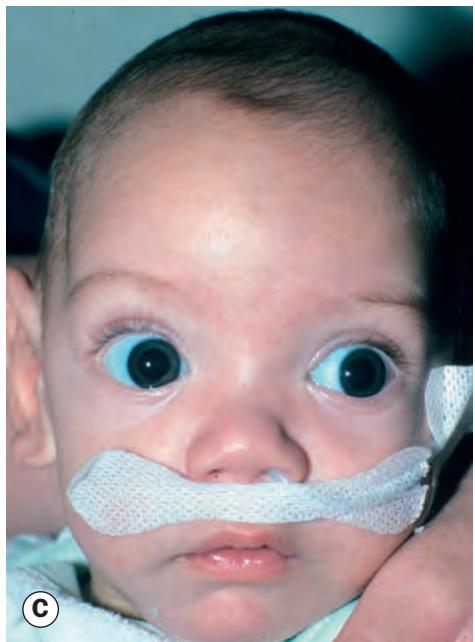

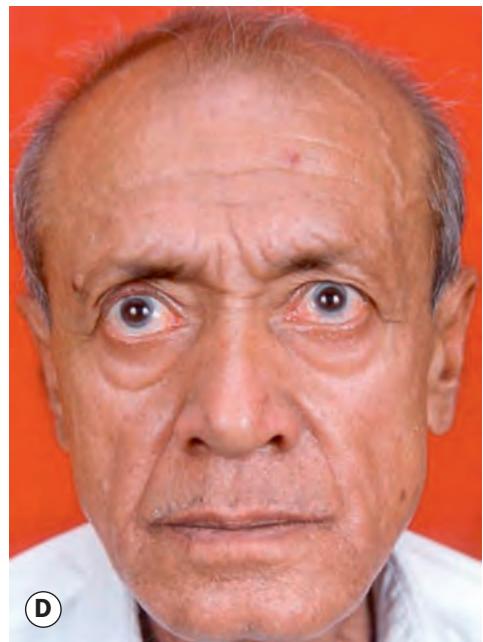

Fig. 1.75 Causes of lid retraction. (A) Unilateral myasthenic ptosis with contralateral lid retraction; (B) Collier sign; (C) ‘setting sun’ sign in infantile hydrocephalus; (D) parkinsonism
(Courtesy of R Bates – fig. C)
posterior, transconjunctival approach. Complications include lower eyelid retraction, contour abnormalities (particularly lateral drooping), and frank ectropion.