Treatment
Treatment of associated OSA is likely to be of benefit; overweight patients should be encouraged to lose weight.
Mild cases may respond to lubrication together with nocturnal eye shield wear or taping of the lids.
Moderate to severe cases require horizontal shortening to stabilize the lid and ocular surface and prevent nocturnal lagophthalmos; a pentagonal excision of 10 mm or more is taken from the junction of the lateral third and medial two-thirds of the upper lid.
Blepharochalasis
Blepharochalasis is an uncommon condition characterized by recurrent episodes of painless, non-pitting oedema of both upper lids which usually resolves spontaneously after a few days. Presentation is usually around puberty, episodes becoming less frequent with time. Eyelid skin becomes stretched and atrophic, characteristically said to resemble wrinkled cigarette paper; severe cases may give rise to stretching of the canthal tendons and levator aponeurosis resulting in ptosis (Fig. 1.73), and lacrimal gland prolapse may occur. A hypertrophic form with orbital fat herniation and an atrophic form with absorption of orbital fat have been described. The differential diagnosis includes similarly episodic conditions, particularly drug-induced urticaria and angioedema. Treatment involves blepharoplasty for redundant upper lid skin, and correction of ptosis.
Eyelid imbrication syndrome
Eyelid imbrication syndrome is an uncommon and frequently unrecognized disorder in which the upper lid overlaps the lower on closure so that the lower lashes irritate the superior marginal tarsal conjunctiva.
It may be unilateral or bilateral and the major symptom is ocular irritation. It can be acquired, commonly associated with floppy eyelid syndrome, or – very rarely – congenital; occasionally it may follow lower lid tarsal strip surgery. Associated signs include superior tarsal papillary conjunctivitis and rose Bengal staining of the superior marginal conjunctiva. Definitive treatment consists of upper lid pentagon resection and/or lateral canthal tightening.

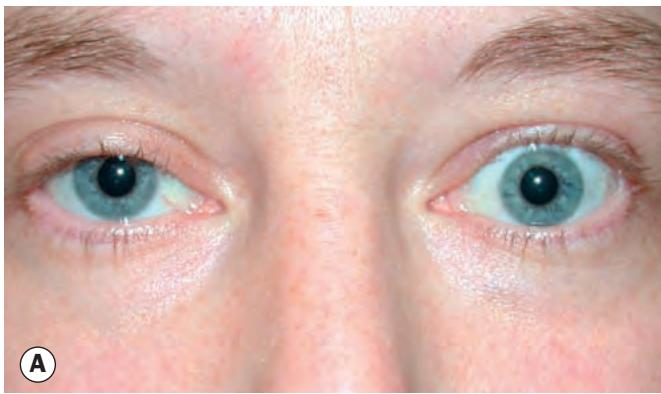
Fig. 1.74 (A) Left lid retraction in thyroid eye disease; (B) following Müller muscle recession
(Courtesy of A Pearson)
Upper lid retraction
Upper lid retraction is suspected when the upper lid margin is either level with or above the superior limbus (Fig. 1.74A); the causes are listed in Table 1.5. Where there is no loss or tightness of the upper eyelid skin, retraction is corrected by surgical release of the eyelid retractors, usually via a transconjunctival posterior approach. Mild retraction may be treated with Müller muscle recession (Fig. 1.74B). Moderate to severe retraction may require levator aponeurosis recession.
Lower lid retraction
Inferior scleral show may be physiological in patients with large eyes or shallow orbits, but is commonly involutional or secondary to some of the conditions in Table 1.5. It may follow lower lid blepharoplasty, when aggressive upward massage of the lid for 2 or 3 months may be curative for minor degrees. In other cases, a tarsal strip operation may raise the lid slightly, but when moderate elevation is required inferior retractor recession with a posterior lamellar spacer is likely to be necessary; more aggressive procedures have been described for severe cases.
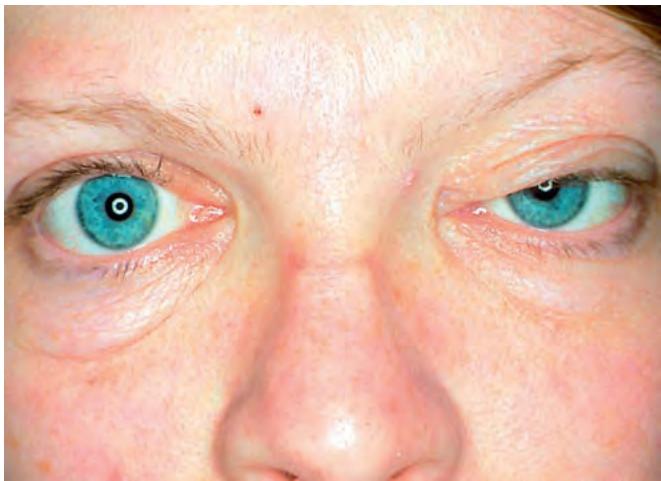
Fig. 1.73 Blepharochalasis – left aponeurotic ptosis and thinned upper lid skin
Cosmetic Eyelid and Periocular Surgery
Table 1.5 Causes of lid retraction
| 1. Thyroid eye disease |
| 2. Neurogenic |
| • Contralateral unilateral ptosis(Fig.1.75A) |
| • Unopposed levator action due to facial palsy |
| • Third nerve misdirection |
| • Marcus Gunn jaw-winking syndrome |
| • Collier sign of the dorsal midbrain(Parinaud syndrome-Fig.1.75B) |
| • Infantile hydrocephalus(setting sun sign-Fig.1.75C) |
| • Parkinsonism(Fig.1.75D) |
| • Sympathomimetic drops |
Mechanical
Congenital
| Surgical over-correction of ptosis |
| Scarring of upper lid skin |
| Isolated |
| Duane retraction syndrome |
| Down syndrome |
| Transient ‘eye popping’ reflex in normal infants |
Miscellaneous
| Prominent globe (pseudo-lid retraction) |
| Uraemia (Summerskill sign) |
| Idiopathic |