Simple congenital ptosis
Diagnosis
Congenital ptosis probably results from a failure of neuronal migration or development with muscular sequelae secondary to this; a minority of patients have a family history.
Signs (Fig. 1.52)
☐ Unilateral or bilateral ptosis of variable severity.
○ Absent upper lid crease and poor levator function.
○ In downgaze the ptotic lid is higher than the normal because of poor relaxation of the levator muscle. This is in contrast to acquired ptosis, in which the affected lid is either level with or lower than the normal lid on downgaze.
○ Following surgical correction the lid lag in downgaze may worsen.
Associations
☐ Superior rectus weakness may be present because of its close embryological association with the levator.
○ Compensatory chin elevation in severe bilateral cases.
○ Refractive errors are common and more frequently responsible for amblyopia than the ptosis itself.
Treatment
Treatment should be carried out during the preschool years once accurate measurements can be obtained, but may be considered earlier in severe cases to prevent amblyopia. Levator resection (see below) is usually required.
Marcus Gunn jaw-winking syndrome
Introduction
About 5% of all cases of congenital ptosis are associated with the Marcus Gunn jaw-winking phenomenon. The vast majority are unilateral. Although the exact aetiology is unclear, it has been postulated that a branch of the mandibular division of the fifth cranial nerve is misdirected to the levator muscle.
Diagnosis
Signs
○ Retraction of the ptotic lid in conjunction with stimulation of the ipsilateral pterygoid muscles by chewing, sucking, opening the mouth (Figs 1.53A and B) or contralateral jaw movement.
○ Less common stimuli to winking include jaw protrusion, smiling, swallowing and clenching of teeth.
☐ Jaw-winking does not improve with age (Figs 1.53C and D), although patients may learn to mask it.
Treatment
Surgery should be considered if jaw-winking or ptosis represents a significant functional or cosmetic problem.
Mild cases with reasonable levator function of 5 mm or better, and little synkinetic movement may be treated with unilateral levator advancement.
Moderate cases. Unilateral levator disinsertion can be performed to address the synkinetic winking component, with ipsilateral brow (frontalis) suspension so that lid elevation is due solely to frontalis muscle elevation.
Bilateral surgery. Bilateral levator disinsertion with bilateral brow suspension may be carried out to produce a symmetrical result.
Third nerve misdirection syndromes
Third nerve misdirection syndromes may be congenital, but more frequently follow acquired third nerve palsy. Bizarre movements of the upper lid accompany various eye movements (Fig. 1.54). Ptosis may also occur following aberrant facial nerve regeneration. Treatment is by levator disinsertion and brow suspension.
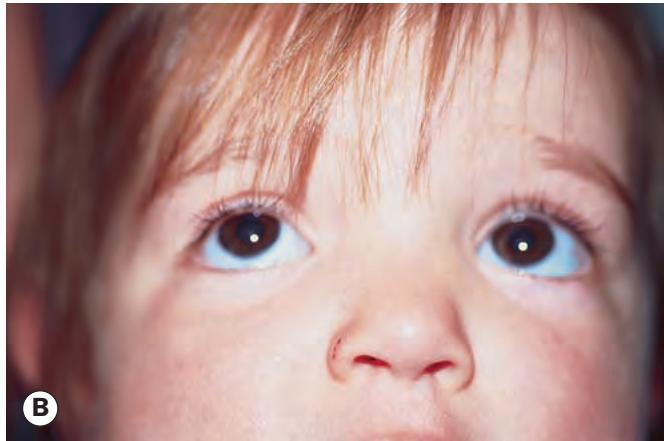
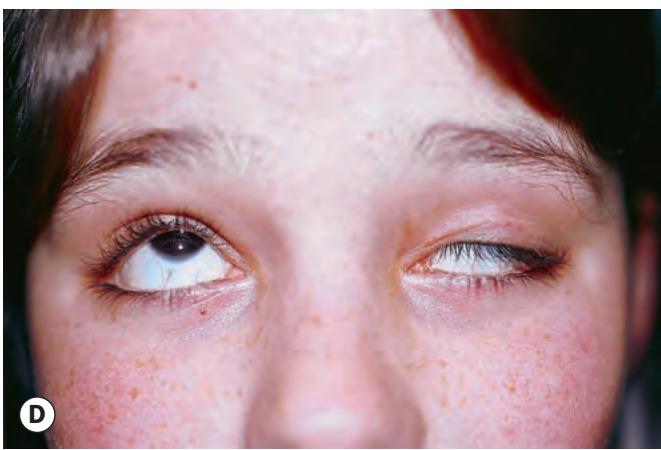
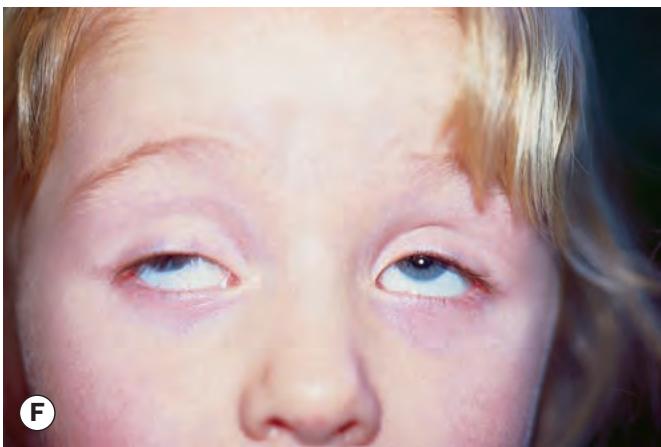
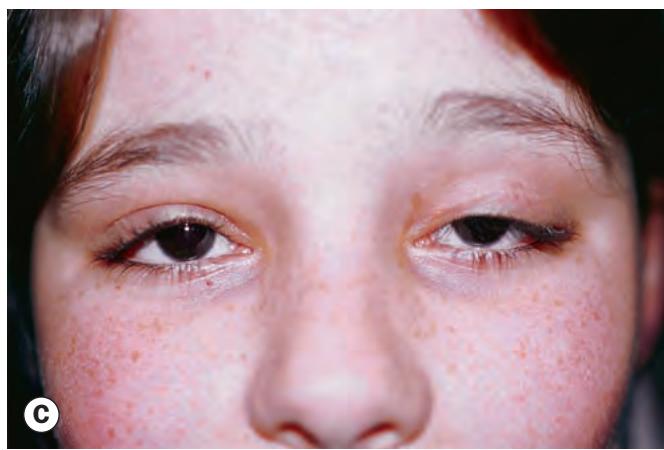
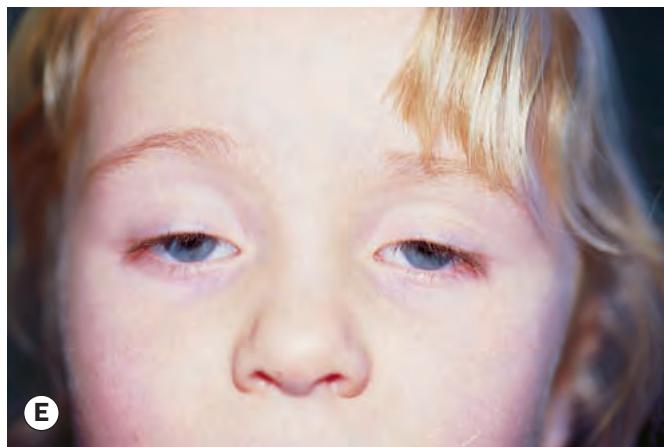

Fig. 1.52 Congenital ptosis. (A) Mild right ptosis; (B) good levator function; (C) severe left ptosis with absent skin crease; (D) very poor levator function; (E) severe bilateral ptosis; (F) very poor levator function