Treatment
Temporary protection must be as short-term as possible; options include lubricants, taping, soft bandage contact lenses and orbicularis chemodenervation with botulinum toxin injection.
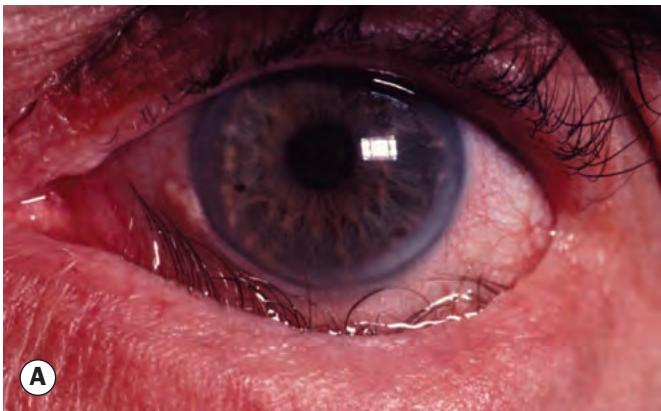
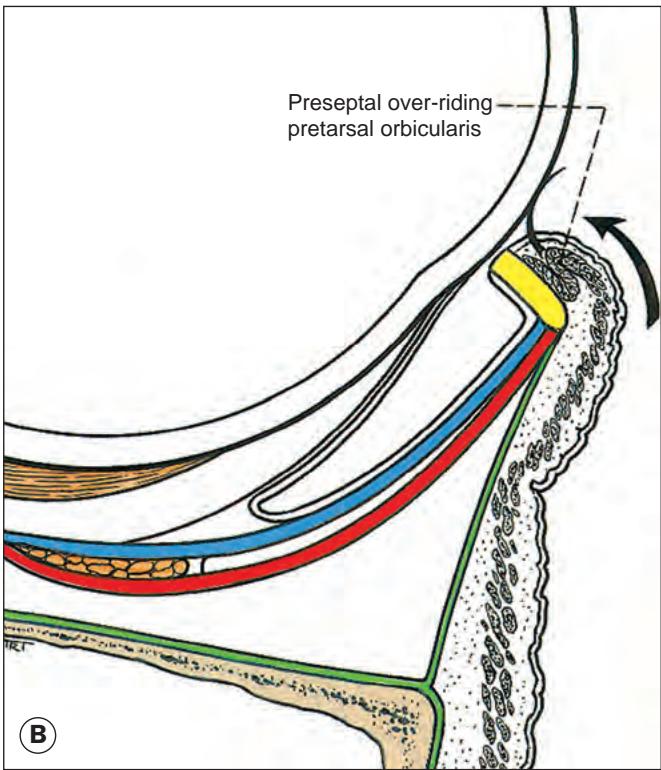
Fig. 1.67 (A) Involutional entropion and pseudotrichiasis;
(B) preseptal orbicularis over-riding the pretarsal orbicularis
Surgical treatment aims to correct the underlying problems as follows:
Over-riding and disinsertion
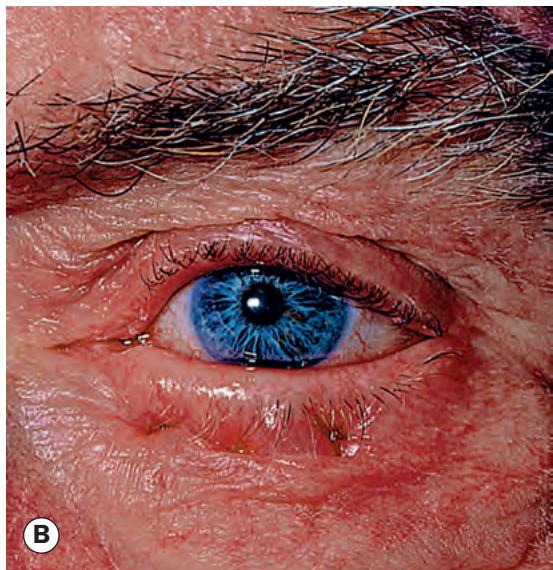
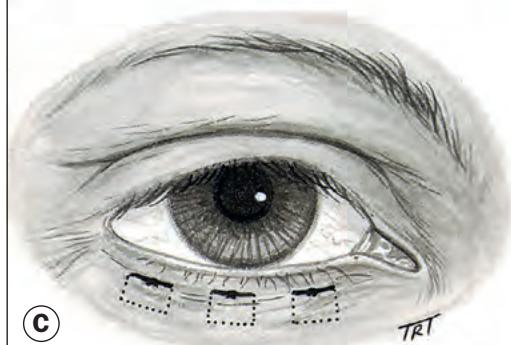
☐ Transverse everting sutures prevent over-riding of the preseptal orbicularis. They are quick and easy to insert (Fig. 1.68), providing a correction typically lasting several months, and may be used in circumstances (e.g. a confused patient) where a more intricate procedure is not likely to be tolerated.
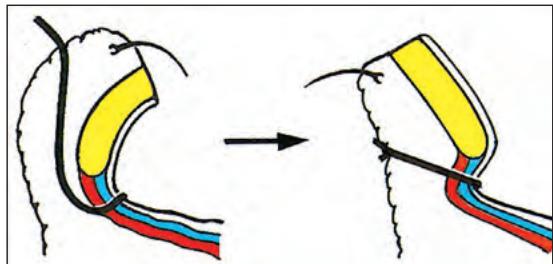
☐ The Wies procedure gives a durable correction. It consists of full-thickness horizontal lid-splitting and insertion of everting sutures (Fig. 1.69). The scar creates a barrier between the preseptal and pretarsal orbicularis, and the everting suture fairly effectively transfers the pull of the lower lid retractors from the tarsal plate to the skin and orbicularis.
○ Lower lid retractor reinsertion (Fig. 1.70) involves direct exposure and advancement of the retractors as opposed to the less precise approach used in the Wies procedure. The subciliary skin incision used, and its repair, also create a barrier to over-riding of the preseptal orbicularis muscle. It can be performed as a primary treatment but may be reserved for recurrence.
Horizontal lid laxity is usually present and can be corrected with a lateral canthal sling (tarsal strip – see Fig. 1.62) or, less commonly, a full-thickness lateral pentagon excision (see Fig. 1.63). Tightening serves also to retain the lid in apposition against the globe, preventing over-correction.
Cicatricial entropion
Scarring of the palpebral conjunctiva can rotate the upper or lower lid margin towards the globe. Causes include cicatrizing conjunctivitis, trachoma, trauma and chemical injuries. Temporary measures are similar to those listed for involutional entropion. Definitive surgical treatment of mild cases is by tarsal fracture (transverse tarsotomy) with anterior rotation of the lid margin, as for marginal entropion of the lower lid. Treatment of severe cases is difficult and is directed at replacing deficient or keratinized conjunctiva and replacing the scarred and contracted tarsal plate with composite grafts.
MISCELLANEOUS ACQUIRED DISORDERS
Varix
An eyelid varix (plural – varices) is a common lesion that may be mistaken for a naevus or haemangioma. A varix is commonly an
Fig. 1.68 Lid-everting sutures for entropion. (A) Three double-armed sutures are passed as shown; (B) sutures are tied; (C) schematic
(Courtesy of AG Tyers and JRO Collin, from Colour Atlas of Ophthalmic Plastic Surgery, Butterworth-Heinemann 2001) isolated lesion, but may be associated with orbital involvement (see Ch. 3). It appears as a dark red or purple subcutaneous compressible (unless thrombosed) lesion (Figs 1.71A and B), which in some cases becomes apparent only with a Valsalva manoeuvre (Figs 1.71C and D). It is clinically and histologically similar to a lymphangioma. Simple excision may be performed for diagnostic or cosmetic reasons; the possibility of orbital communication should be borne in mind during surgery.

Miscellaneous Acquired Disorders