Treatment
In many patients things will gradually settle without treatment over about a week. If treatment is necessary, a topical (aciclovir cream five times daily for 5 days) or oral (oral aciclovir, famciclovir or valaciclovir) antiviral agent can be used. Antibiotics (e.g. co-amoxiclav, erythromycin) may also be required in patients with secondary bacterial infection; this is particularly common in eczema herpeticum.
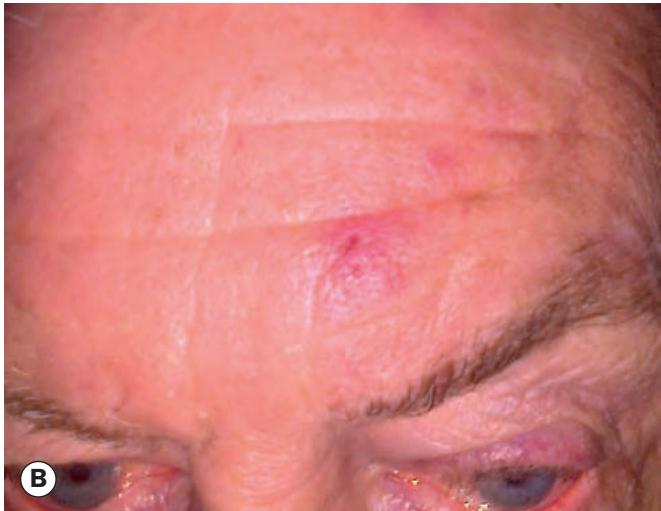
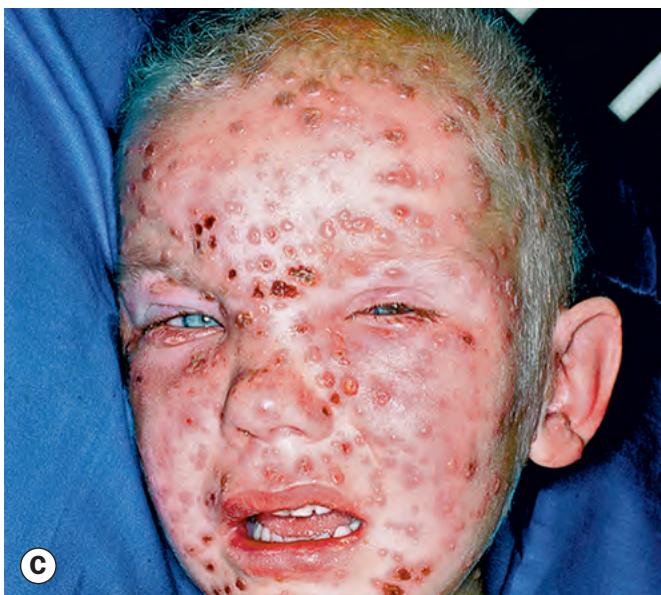
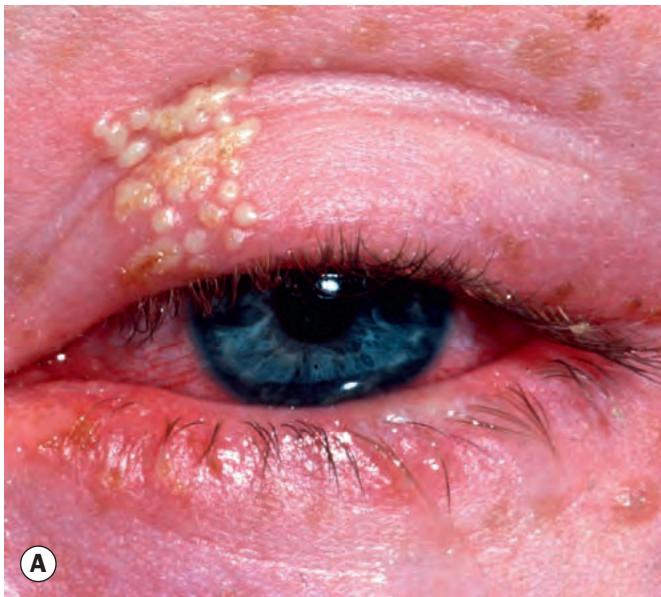
Fig. 1.41 Herpes simplex. (A) Vesicles; (B) progression to crusting; (C) eczema herpeticum
BLEPHARITIS
Chronic blepharitis
Introduction
Chronic blepharitis (chronic marginal blepharitis) is a very common cause of ocular discomfort and irritation. The poor correlation between symptoms and signs, the uncertain aetiology and mechanisms of the disease process all combine to make management difficult. Blepharitis may be subdivided into anterior and posterior, although there is considerable overlap and both types are often present (mixed blepharitis).
Anterior blepharitis affects the area surrounding the bases of the eyelashes and may be staphylococcal or seborrhoeic. It is sometimes regarded as related more to chronic infective elements and hence more amenable to treatment and remission than the posterior form. An aetiological factor in staphylococcal blepharitis may be an abnormal cell-mediated response to components of the cell wall of S. aureus, which may also be responsible for the red eyes and peripheral corneal infiltrates seen in some patients; it is more common and more marked in patients with atopic dermatitis.
Seborrhoeic blepharitis is strongly associated with generalized seborrhoeic dermatitis that characteristically involves the scalp, nasolabial folds, skin behind the ears and the sternum.
Posterior blepharitis is caused by meibomian gland dysfunction and alterations in meibomian gland secretions. Bacterial lipases may result in the formation of free fatty acids. This increases the melting point of the meibum, preventing its expression from the glands, contributing to ocular surface irritation and possibly enabling growth of S.
aureus. Loss of the tear film phospholipids that act as surfactants results in increased tear evaporation and osmolarity, and an unstable tear film. Posterior blepharitis is commonly thought of as a more persistent and chronic inflammatory condition than anterior blepharitis; there is an association with acne rosacea.
A reaction to the extremely common hair follicle and sebaceous gland-dwelling mite Demodex and other microorganisms may play a causative role in some patients
– Demodex folliculorum longus in anterior blepharitis and Demodex folliculorum brevis in posterior blepharitis – though the mite can be found normally in a majority of older patients, most of whom do not develop symptomatic blepharitis. It has been proposed that circumstances such as overpopulation or hypersensitivity (perhaps to a bacillus carried symbiotically by Demodex) may lead to symptoms.
Demodex mites are a major cause of the animal disease mange.
The characteristics of the different forms of blepharitis are set out in Table 1.4.
Diagnosis
Involvement is usually bilateral and symmetrical.
Symptoms are caused by disruption of normal ocular surface function and reduction in tear stability, and are similar in all forms of blepharitis, though stinging may be more common in posterior disease. Because of poor correlation between the severity of symptoms and signs it can be difficult to objectively assess the benefit of treatment.
Burning, grittiness, mild photophobia, and crusting and redness of the lid margins with remissions and exacerbations are characteristic. Symptoms are usually worse in the mornings although in patients with associated dry eye they
Table 1.4 Summary of characteristics of chronic blepharitis
| Feature | Anterior blepharitis | Posterior blepharitis | ||
| Staphylococcal | Seborrhoeic | |||
| Lashes | Deposit | Hard | Soft | |
| Loss | ++ | + | ||
| Distorted or trichiasis | ++ | + | ||
| Lid margin | Ulceration | + | ++ | |
| Notching | + | |||
| Cyst | Hordeolum | ++ | ++ | |
| Meibomian | ||||
| Conjunctiva | Phlyctenule | + | ||
| Tear film | Foaming | ++ | ||
| Dry eye | + | + | ++ | |
| Cornea | Punctate erosions | + | + | ++ |
| Vascularization | + | + | ++ | |
| Infiltrates | + | + | ++ | |
| Commonly associated skin disease | Atopic dermatitis | Seborrhoeic dermatitis | Acne rosacea | |
may increase during the day. Contact lens wear may be poorly tolerated.