Objective Eye Movement Recording
The third approach to the assessment of saccades is objective eye movement recording. The clinical devices available for this purpose are the Readalyzer and the Visagraph II. These systems consist of infrared monitoring eyeglasses and a recording unit (Fig. 1.9), both of which are attached to a PC-compatible computer.
A
B
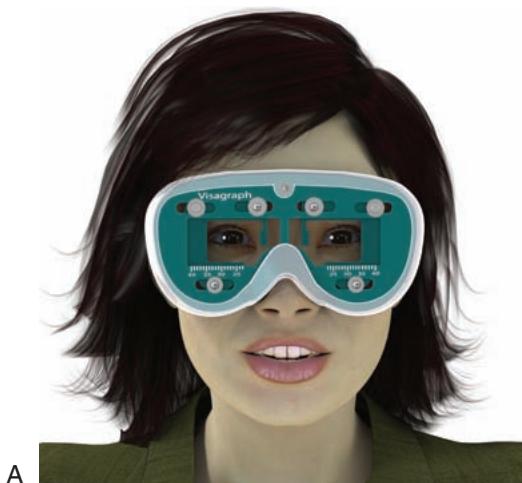
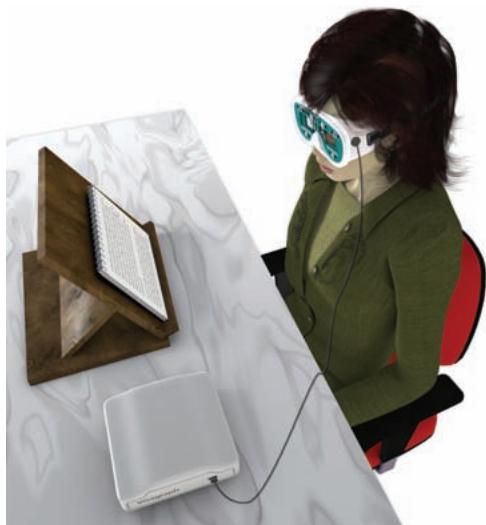
Figure 1.9 A: Visagraph II instrument, goggles, and reading selections. B: Visagraph II used for assessment of eye movements.
Objective eye movement recording has several advantages over direct observation and timed/standardized tests. It is an objective procedure that does not depend on the skill of the examiner, and the Readalyzer and Visagraph II provide a permanent recording of the evaluation. The information gained from objective recording is also more sophisticated. It provides information about number of fixations, regressions, duration of fixations, reading rate, relative efficiency, and grade equivalence. All of this information can be compared to established norms for elementary schoolchildren through adulthood.
The disadvantage of both the Readalyzer and Visagraph II is the expense of the instruments. The test is also difficult to use with patients who are inattentive, hyperactive, or have poor fixation. The testing procedure and interpretation of results are discussed in detail elsewhere (88). Although these instruments are commonly used in optometric practice, until recently there had been no universally accepted standard protocol. Colby et al. (89) demonstrated that the Visagraph II worked very well with a group of 50 first-year optometry students and produced data that seemed to be reliable indicators of reading skill; they suggested at least one practice trial before the actual reading baseline measurements are obtained. A more recent study (90) reported that at least three practice paragraphs should be administered prior to formal testing with the Visagraph II to ensure a valid and stable baseline determination in adult patients. Ciuffreda et al. (90) also suggested an explicit set of procedural guidelines to obtain reliable, valid, and stable baseline reading levels. They stress the proper setup of the goggles and text materials as well as a full, clear, and consistent instructional set. Dixon et al. (91) compared the use of 100- versus 800-word reading passages with the Readalyzer. They found that both symptomatic and asymptomatic subjects had more difficulty on longer reading passages. They suggest that the use of the longer reading passages is a more sensitive method for assessing reading eye movements.
In the only study evaluating the repeatability of the Visagraph II in children, Borsting et al. (92) recruited 22 children from a clinical population in grades 3 to 8 (mean grade 5.1). Four Visagraph trials were performed (the first was a practice session) at the first visit and again about 1 week later. They reported repeatability of data that can help clinicians determine whether changes in reading eye movements made during vision therapy are real or accounted for by normal variability. They suggested using absolute values (i.e., fixations, regressions, reading duration of fixation, span of recognition, rate) rather than grade equivalents when making decisions about changes in the Visagraph results after treatment.
Recommendations
We suggest that clinicians working in a primary care setting use a combination of direct observation, using the rating scale and normative data in Tables 1.8 and 1.9, along with the DEM test. This should provide sufficient information for making both diagnostic and therapeutic decisions. For those clinicians who intend to devote a considerable percentage of their practices dealing with oculomotor problems, the Readalyzer or Visagraph II should be considered because of its ability to provide objective documentation of progress during therapy.
Expected Values
Refer to Table 1.11 for expected findings for the NSUCO oculomotor test. For the DEM, any score below the 15th percentile is considered significant.
Pursuit
The purpose of pursuit testing is to assess the quality and accuracy of pursuit function.
Testing Format
There are not as many testing alternatives for pursuits as there are for saccades. Direct observation of the patient following a moving target is the most commonly used clinical technique. Several rating scales have been developed for direct observation of pursuit movements. We recommend use of the NSUCO oculomotor test for the reasons just described.
For the pursuit portion of the NSUCO oculomotor test, the patient is asked to stand directly in front of the examiner. One target is used and held at the Harmon distance or no farther than 40 cm from the patient. The examiner holds the target at the midline of the patient’s body and moves it in a circle of no more than 20 cm diameter. The patient is asked to follow the target as it goes around. Two clockwise rotations and two counterclockwise rotations are made. A sweep horizontally through the midline of the body is made when switching from clockwise to counterclockwise rotation. No instructions are given to the patient to move or not to move his or her head. The examiner observes the pursuit eye movements and rates the performance in four categories: head movement, body movement, ability, and accuracy (Table 1.12).
TABLE 1.12 NSUCO Scoring Criteria: Direct Observation of Pursuits
| Ability | |
| Points | Observation |
| 1 | Cannot complete 1/2 rotation in either clockwise or counterclockwise direction |
| 2 | Completes 1/2 rotation in either direction |
| 3 | Completes one rotation in either direction but not two rotations |
| 4 | Completes two rotations in one direction but less than two rotations in the other direction |
| 5 | Completes two rotations in each direction |
| Accuracy (Can the patient accurately and consistently fixate so that no noticeable refixation is needed when doing pursuits?) | |
| Points | Observation |
| 1 | No attempt to follow the target or requires greater than 10 refixations |
| 2 | Refixations 5 to 10 times |
| 3 | Refixations 3 to 4 times |
| 4 | Refixations 2 times or less |
| 5 | No refixations |
| Head and body movement (Can the patient accomplish the pursuit without moving his or her head?) | |
| Points | Observation |
| 1 | Large movement of the head or body at any time |
| 2 | Moderate movement of the head or body at any time |
| 3 | Slight movement of the head or body (>50% of time) |
| 4 | Slight movement of the head or body (<50% of time) |
| 5 | No movement of head or body |
Although several rating scales have been developed to create better uniformity in observation (3,73,74), only the NSUCO oculomotor test has been shown to be both reliable and repeatable (72,74). Table 1.13 shows normative data for this test.