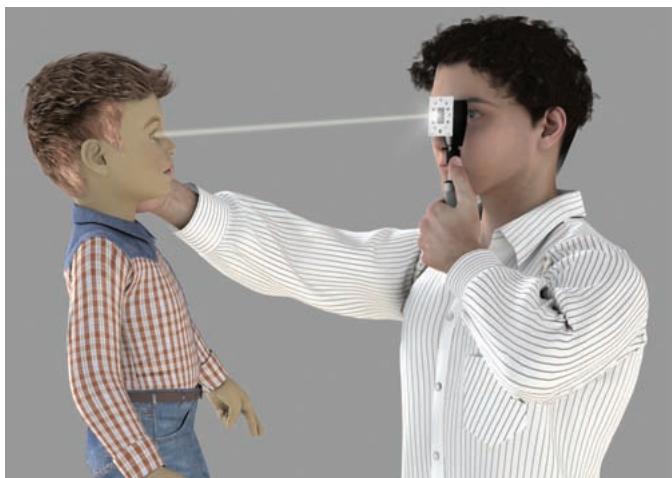
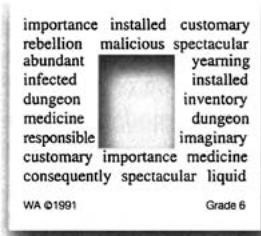
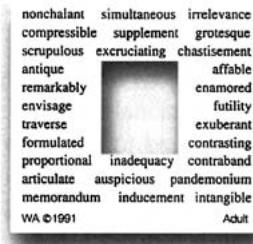


Figure 1.7 A: Monocular estimation method (MEM) cards used for MEM retinoscopy. B: MEM retinoscopy—clinical procedure.
(c) Lighting When performing MEM retinoscopy, it is important to use normal room illumination. Accommodation is affected by illumination (e.g., dark focus), and dim illumination will alter the accommodative response. Accommodation should therefore be tested under illumination that the patient habitually uses.
Expected values The expected value for MEM retinoscopy is + 0.25D to + 0.50D, with a standard deviation of + 0.25D. A finding below plano or above + 0.75D should therefore raise suspicion.
Fused Cross-cylinder Test
1. Purpose A subjective method to evaluate the accuracy of the accommodative response.
2. Important issues Because the fused cross-cylinder test is a subjective method, it is difficult to use with children younger than 8 to 9 years. It is generally easier and faster to perform MEM retinoscopy. This test is also not as repeatable as MEM retinoscopy.
3. Expected values The expected value for the binocular fused cross-cylinder test is +0.50 D with a standard deviation of ± 0.50 D (19).
Evaluation of Eye Movements
Examination of eye movements involves three distinct steps: assessment of stability of fixation, saccadic function, and pursuit function (Table 1.7). Ocular motor disorders can reflect serious underlying central nervous system disease or functional or developmental problems. It is always important to consider the possibility that abnormalities in fixation stability, saccades, and pursuits may require a neurologic consultation. This is discussed in detail in Chapter 13 (Table 1.8).
The main reason for clinically assessing eye movement function is that reading consists of a series of saccades and fixations. Research has demonstrated that poor readers read more slowly and exhibit smaller and more numerous fixations and regressions. Although more research is necessary to firmly establish the causal relationship between eye movements and reading, the fact that poor readers do behave differently has prompted a great deal of interest in assessing these skills (Chapter 13).
EVALUATION OF FIXATION STABILITY
This test evaluates the ability of the patient to maintain steady fixation on a fixation object. The most important issue to keep in mind is that assessment of fixation is often overlooked in a routine examination. Asking the patient to fixate on a target during the initial external evaluation or during cover testing is sufficient to evaluate fixation status. A variety of disorders of fixation can occur and may represent organic or functional anomalies (Table 1.9).
All patients, except the very young, anxious, hyperactive, or inattentive, should be able to sustain precise fixation, with no observable movement of the eyes, for 10 seconds (70,71).
Saccades
The purpose of saccadic testing is to assess the quality and accuracy of saccadic function.
TABLE 1.8 Important Aspects of Ocular Motor Testing
| Fixation ability | Observation of fixation for 10 sec |
| Saccadic eye movements | Developmental eye movement Readalyzer or Visagraph II NSUCO oculomotor test |
| Pursuit eye movements | NSUCO oculomotor test |
NSUCO, Northeastern State University College of Optometry.
TABLE 1.9 Pathologic Conditions Associated with Eye Movement Disorders
| Disorders of fixation | |
| Peripheral micronystagmus | Congenital nystagmus |
| Ocular flutter | Latent nystagmus |
| Opsoclonus | Acquired nystagmus |
| Square wave jerks | Spasmus nutans |
| Ocular myoclonus | Superior oblique myokymia |
| Ocular bobbing | |
| Disorders of saccadic movements | |
| Congenital ocular motor apraxia | Progressive supranuclear palsy |
| Acquired ocular motor apraxia | Dysmetria |
| Huntington chorea | Disconjugate saccades (internuclear ophthalmoplegia) |
| Disorders of pursuit movements | |
| Unilateral pursuit paresis | Progressive supranuclear palsy |
| Cogwheeling | |