(c) Monocular versus binocular testing Should testing be done monocularly and binocularly? This would require repetition of the test three times, which can be time consuming in a routine examination. Binocular testing is an assessment of the interactions between accommodation and vergence and is not a pure measurement of accommodative facility. If a patient is binocular, the introduction of minus lenses, for instance, will require the patient to stimulate accommodation to maintain clarity. As the patient accommodates, accommodative convergence will be stimulated as well and the patient will lose binocularity unless he or she makes a compensatory response. To prevent the loss of binocularity, the patient must use negative fusional vergence to compensate for the accommodative convergence. Thus, as minus lenses are introduced, the ability to stimulate accommodation and negative fusional vergence are both being assessed. A problem in either area could result in poor performance.
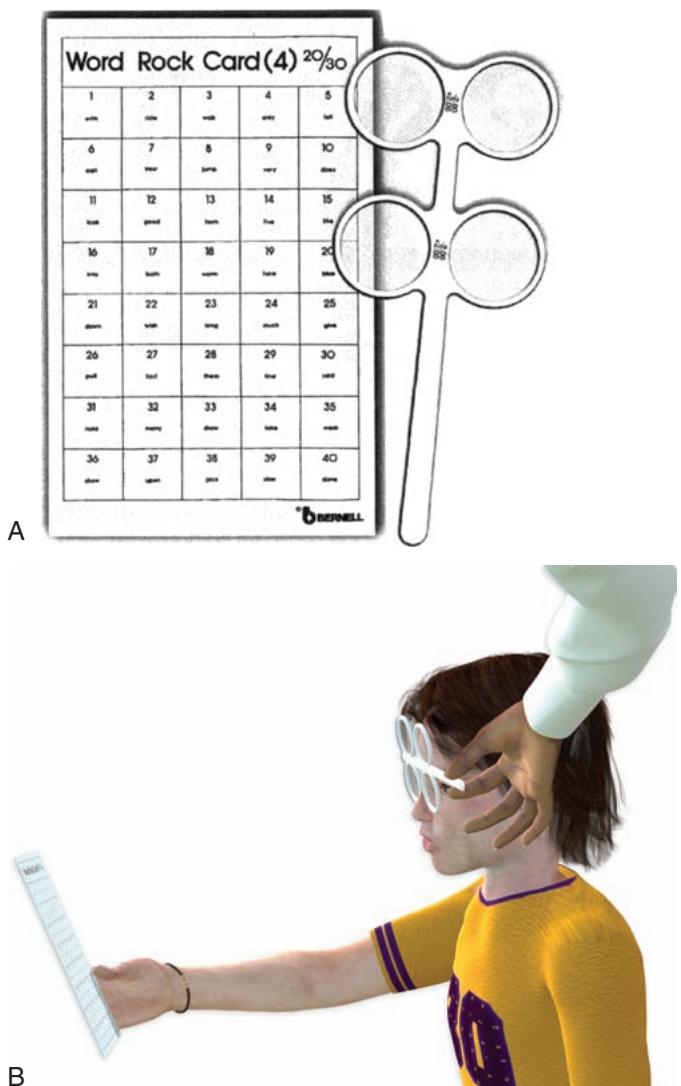
Figure 1.5 A: The Accommodative Rock Cards. B: The Accommodative Rock Cards being used for accommodative facility testing.
We recommend routine use of BAF testing. A normal response on BAF testing suggests normal function in both areas. If a patient experiences difficulty with binocular testing, then monocular testing can be administered. Monocular testing, in this case, would be diagnostic. If the patient cannot clear minus lenses binocularly or monocularly, an accommodative problem is present. If, however, the patient fails binocularly and passes monocularly, a binocular vision problem is more likely.
(d) Target for binocular testing The importance of using a suppression control when performing BAF testing has been stressed in the literature (51,54–56). The target that is generally used is the Bernell No. 9 vectogram. This is a Polaroid target (Fig. 1.6) that has one line seen by the right eye, one by the left eye, and one by both. This target has also been used in studies that developed expected values for adults. As a result, the No. 9 vectogram is the target of choice. Other binocular targets with suppression controls could be used, but it is important to remember that the expected values for this test were developed using the No. 9 vectogram.
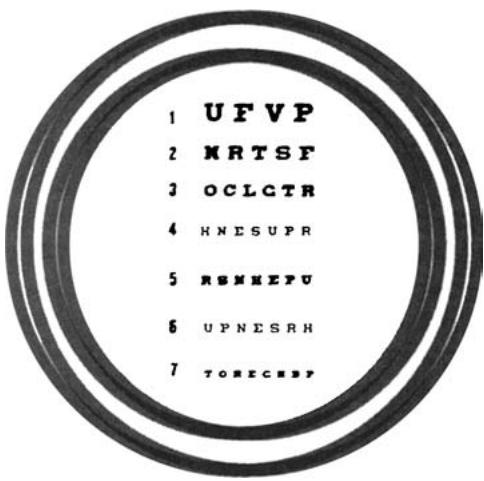
Figure 1.6 Bernell No. 9 vectogram used for binocular accommodative facility testing.
3. Expected values Table 1.6 lists expected values for schoolchildren. For adults, we suggest using amplitude scaled testing and Table 1.7. In the remainder of this text, we discuss diagnosis using ±2. 0 0 lenses at 40 cm.
ASSESSMENT OF ACCOMMODATIVE RESPONSE
Monocular Estimation Method Retinoscopy
1. Purpose An objective method to evaluate the accuracy of the accommodative response.
Important issues
(a) Testing must be done with the subjective MEM retinoscopy is a form of near point retinoscopy. MEM cards (Fig. 1.7) are available for the Welch Allyn retinoscope and magnetically attach to the retinoscope head. The working distance should be at 40 cm for adults or at the Harmon distance (the distance from the patient’s elbow to the middle knuckle) for children. Select an MEM card that is appropriate for the age and grade level of the patient. While the patient reads the words on the card, perform retinoscopy along the horizontal axis and estimate the amount of plus or minus necessary to neutralize the motion of the retinoscopic reflex observed. A lens can be quickly placed before the eye being evaluated to confirm the estimate. It is important, however, not to leave the lens in place too long because it can alter the accommodative response.
Interpretation of the results of MEM testing is based on the assumption that the accommodative stimulus at distance has been reduced to zero. If the patient is not wearing the subjective or has been overcorrected or undercorrected, interpretation of the MEM result will be affected. For example, an MEM finding of +1.25 D is considered to represent underaccommodation. If, however, the patient is a hyperope and is not wearing his or her glasses, the MEM finding in this case would simply reflect the presence of this uncorrected hyperopia. Similarly, an uncorrected myope might exhibit less plus than expected on MEM retinoscopy.
(b) The results of MEM testing reflect both accommodative and binocular function Any testing performed under binocular conditions is affected by both accommodative and binocular function. Thus, although MEM is considered a test of accommodative function, binocular vision is also being assessed. For example, a finding of less plus than expected may reflect overaccommodation secondary to accommodative excess or high exophoria and decreased positive fusional vergence.
A patient with high exophoria and inadequate positive fusional vergence may use accommodative convergence to supplement the inadequate fusional vergence. This would enable the individual to maintain binocularity, although it may lead to blurred vision secondary to the overaccommodation.
The same reasoning applies to a finding of more plus than expected on MEM retinoscopy. This could suggest either underaccommodation secondary to accommodative insufficiency or high esophoria and reduced negative fusional vergence.
A
B