ASSESSMENT OF SIZE AND DIRECTION OF THE PHORIA OR FIXATION DISPARITY
Cover Test (in the Absence of Strabismus)
1. Purpose The cover test is an objective method of evaluating the presence, direction, and the magnitude of the phoria.
Important issues
(a) Controlling accommodation The most important aspect of the cover test procedure, or any other test of binocular alignment, is control of accommodation. A study by Howarth and Heron (12) reaffirmed the significance of the accommodative system as a potential source of variability in clinical heterophoria measurement. Underaccommodation will result in an overestimation of the degree of exophoria or an underestimation of the esophoria. Overaccommodation will yield the opposite results. There are two techniques that can be used to maximize control of accommodation during the cover test procedure. These refinements to the basic procedure tend to increase attention on the task. The examiner can use multiple fixation targets to maintain attention and accommodation on the task. This can easily be accomplished using Gulden fixation sticks that have 20/30 targets on both sides of the stick (Fig. 1.2). Periodically, the fixation stick is turned around to change targets. The patient is asked to identify the target during the cover test.
Another useful procedure is to move the target left to right very slightly (1 to 3 cm) between movements of the cover paddle. The examiner looks for a small pursuit movement in the uncovered eye. If a pursuit movement occurs when the target is moved left to right, it suggests that the patient is attending to the target. Attention on the target tends to encourage accommodation.
(b) Objectivity Because the cover test is an objective technique, it is one of the most valuable methods for assessing the motor characteristics of binocularity. It becomes particularly valuable when working with young children.
(c) Repeatability Johns et al. (13) found that the alternate cover test with prism neutralization has high intraexaminer and interexaminer repeatability.
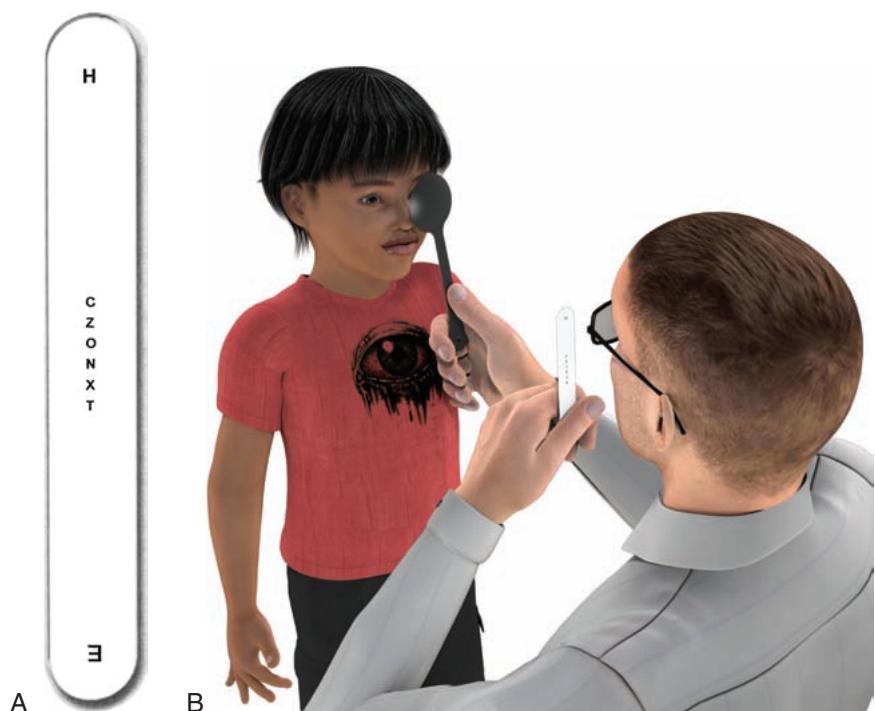
Figure 1.2 A: Gulden fixation stick. B: Gulden fixation sticks with small targets used as a fixation target.
TABLE 1.2 Revised Newcastle Control Score
| Home Control | |
| XT or monocular eye closure seen | |
| 0 | Never |
| 1 | <50% of time fixing at distance |
| 2 | <50% of time fixing at distance |
| 3 | 50% of time fixing in distance + seen at near |
| Clinic Control | |
| Near | |
| 0 | Immediate realignment after dissociation |
| 1 | Realignment with aid of blink or refixation |
| 2 | Remains manifest after dissociation/prolonged fixation |
| 3 | Manifest spontaneously |
| Distance | |
| 0 | Immediate realignment after dissociation |
| 1 | Realignment with aid of blink or refixation |
| 2 | Remains manifest after dissociation/prolonged fixation |
| 3 | Manifest spontaneously |
Total Newcastle Scale Score: (Home + Near + Distance).
(d) Assessing frequency and control of the deviation When an intermittent strabismus is detected using the cover test an additional assessment must be made of the proportion of time the eye is deviated, or the frequency of the deviation. This can also be referred to as control of the deviation. It is commonly believed that a worsening of control in intermittent exotropia is an indication for vision therapy or surgical intervention. The problem is that until recently precise criteria for progression have not been established.
Haggerty et al. (14) described the Newcastle Control Score that they developed as a tool to assess control of an intermittent exotropia deviation. The scale incorporates both objective (office assessment) and subjective measures (home assessment by parents) of control into a grading system that differentiates and quantifies the various levels of severity in intermittent exotropia. The authors suggest that the scale is a consistent and robust method of rating severity that can be used accurately in clinical practice. Hatt et al. (15), however, questioned the reliability of parental observations. The revised Newcastle Control Score (16) is illustrated in Table 1.2.
Mohney and Holmes (17) developed an office-based scale that can describe the wide range of control in patients with intermittent exotropia and avoids many of the weaknesses of prior systems. It provides a quantitative measure of the severity and duration of the manifest component of the exodeviation and is useful for the longitudinal evaluation of patients with intermittent exotropia. Hatt et al. (18) used this scale with 12 children with intermittent XT and they were evaluated during 4 sessions (2 hours apart) over a day on 2 separate days (8 sessions per child). Control was standardized using the scoring system and quantified three times during each examination. They found that the mean of three assessments of control during a clinic examination better represents overall control than a single measure. This scale is illustrated in Table 1.3.
TABLE 1.3 Intermittent Exotropia Control Scale
| Control Score | Control Score Description |
| 5 | Constant exotropia during a 30-sec observation period (before dissociation) |
| 4 | Exotropia 50% of the time during a 30-sec observation period (before dissociation) |
| 3 | Exotropia 50% of the time during a 30-sec observation period (before dissociation) |
| 2 | No exotropia unless dissociated (10 sec): recovery in 5 sec |
| 1 | No exotropia unless dissociated (10 sec): recovery in 1–5 sec |
| 0 | Pure phoria: 1-sec recovery after 10-sec dissociation |
3. Expected values Although the expected finding for the cover test has not been specifically studied, we expect it to be similar to the values found during phoria testing. At distance, the expected value is 1 exophoria, with a standard deviation of ±1Δ. The mean expected value at near is 3 exophoria, with a standard deviation of ±3Δ (19).