9

A 73-year-old man reports blurry vision, especially in his right eye. He says he was told he has cataracts but wants a second opinion about surgery. His old glasses are –3.00 +0.75 × 180 OU, and he says he used to have equal vision in both eyes. On exam, you find his manifest refraction is –6.25 +2.00 × 15 OD and –5.00 +1.00 × 180 OS giving BSCVA of 20/70 OD and 20/25 OS. There is a 4+ nuclear sclerotic/2+ posterior subcapsular cataract OD and a 4+ nuclear sclerotic cataract OS. The rest of the eye exam is normal.
What additional information would be helpful?
How would you advise this patient regarding cataract surgery?
More information about the history and symptoms would be helpful: How long has he been having trouble with his vision? How does the reduced vision interfere with his activities (ie, reading, driving, watching TV, computer work, hobbies, glare/halo/starbursts, etc.)? What are his activities/hobbies and how has he used glasses or contact lenses in the past?
Results of pinhole vision and PAM for OD, and glare test (BAT) for OS would be helpful for determining visual potential OD and visual significance of the cataract OS.
This patient has a visually significant cataract OD and possibly one OS, and he also has a large myopic shift with anisometropia. The main issues regarding surgery are the desired refractive outcome and timing of surgery OS.
Refractive outcome: it is important to inquire about the patient’s visual needs and preferred use of glasses for various distances. Since he was a low myope, he may like to read or do close work without glasses and does not mind wearing glasses for driving, so he may prefer a monofocal IOL targeted for reading vision. On the other hand, he may have always found glasses a nuisance and would like to reduce his dependence on them as much as possible, so he may prefer multifocal/EDOF/accommodating IOLs or monovision. Therefore, the various IOL options must be discussed thoroughly.
Timing of surgery OS: it is also necessary to inform the patient about potential problems with anisometropia/aniseikonia and how this can be addressed with a contact lens if he does not want cataract surgery OS shortly after OD, particularly if he desires full distance correction with cataract surgery OD.
10
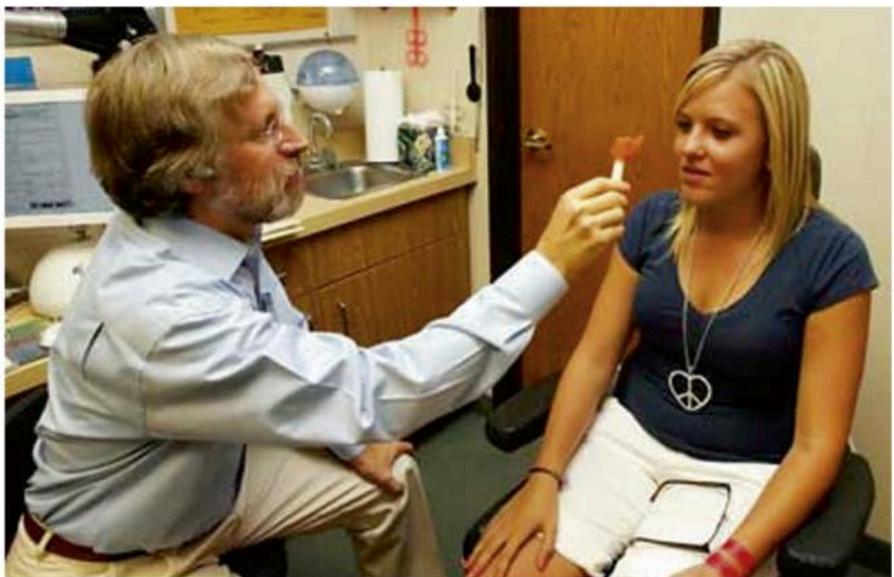
A 23-year-old graduate student complains of headache and eyestrain for the past year. She says her vision has always been fine, but a few years ago she was prescribed a pair of reading glasses. They helped only a little, so she wore them occasionally but lost them after a year. Her past ocular history is otherwise unremarkable.
What is the differential diagnosis and how would you determine the diagnosis?
Additional information: she has no past medical history and is not taking any medicines. Her manifest refraction is plano OU, cycloplegic refraction is +0.50 D OU, extraocular motility is full, the eyes are orthophoric at distance and there is a 6 PD exophoria at near, accommodative amplitude is normal.
What is the diagnosis?
How would you treat this patient?
The differential diagnosis includes hyperopia, accommodative insufficiency, and convergence insufficiency.
Accommodative insufficiency is associated with systemic processes such as hypothyroidism, anemia, pregnancy, nutritional deficiencies, and chronic illness, so she should be questioned about her past medical history and current medications. The relevant parts of the eye exam to distinguish among the possible etiologies are: manifest and cycloplegic refractions, ocular alignment and motility, near and far points, accommodative and convergence amplitudes. Hyperopia would be revealed by the refractions (other tests would be normal), and convergence insufficiency would be diagnosed by exophoria greater at near than distance.
Convergence insufficiency.
Orthoptic exercises to improve fusional amplitudes, such as pencil push-ups, may be helpful. Another option is base-out prism glasses to stimulate convergence. Rarely is surgery (medial rectus resection) required.

A 51-year-old woman underwent retinal detachment repair with scleral buckle of the right eye 2 weeks ago. Her macula was not affected. She notices that her vision is blurry and she is seeing double. Her uncorrected visual acuity is 20/60 OD and 20/20 OS.
What is the most likely cause of her complaints?
What single test would help determine the etiology?
Additional information: pinhole improves her vision to 20/20 OD, but does not resolve the diplopia. Her manifest refraction is –2.25 +0.75 × 135 OD and plano OS. She has a right exotropia of 8 PD and hypertropia of 3 PD.
How would you manage her?
What is the definition of a PD?
How are deviations measured with plastic prisms and with glass prisms?
How does a minus lens affect the measurement of a tropia?
The blurry vision is most likely due to induced myopia (and possible astigmatism) from the scleral buckle, but could be a result of damage from the retinal detachment. The diplopia may also be due to the induced ametropia, but could be caused by strabismus from the scleral buckle.
Pinhole vision. If the vision improves, then the blurriness is due to a refractive error. If the diplopia improves, then this is also related to the blurry vision and ametropia. If the diplopia does not improve, then an ocular misalignment is present.
She should be given her full glasses prescription with prism correction to alleviate the diplopia. Strabismus surgery or buckle removal could be considered in the future.
The displacement (in cm) of a light ray passing through a prism, measured 100 cm (1 m) from the prism.
Plastic prisms are held with the back surface parallel to the frontal plane. Glass prisms are held in the Prentice position with the back surface perpendicular to the visual axis. The apex of the prism is pointed in the direction of the eye deviation (ie, base-in for exotropia). Stacking prisms is not additive, but holding prisms in front of each eye is.
Minus measures more. Minus lenses make the deviation appear larger; plus lenses decrease the measured deviation. The prismatic effect of glasses on strabismic deviations is calculated as follows: 2.5 ×D = % difference.