22
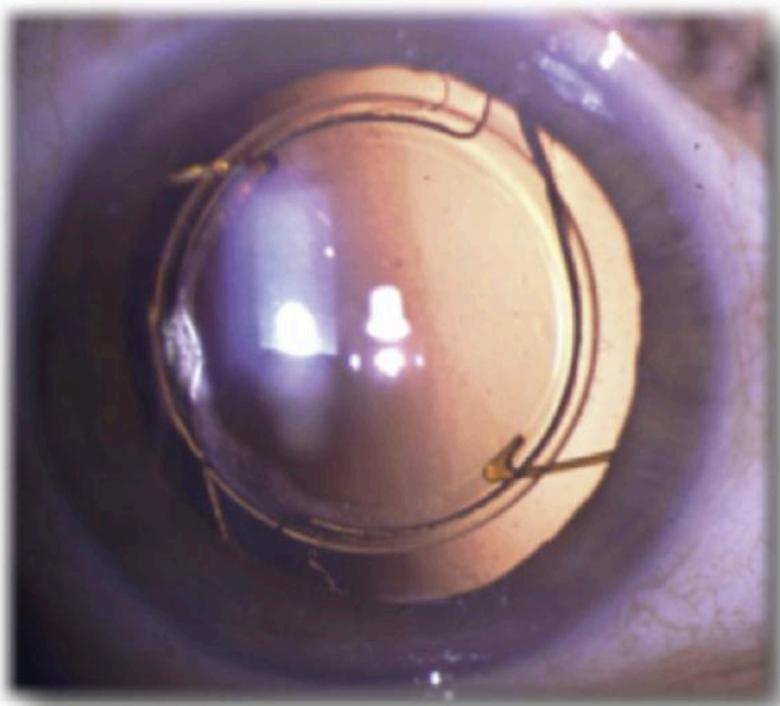
(Courtesy of Samuel Masket, MD)
A 72-year-old woman has a +2.00 D refractive surprise after cataract surgery and desires a piggyback IOL procedure.
How is the correct piggyback IOL power calculated, and what power does this patient require for emmetropia?
What are the necessary considerations when planning to perform a piggyback IOL procedure?
As a general guideline, to correct myopia the necessary IOL power is 1.2 times the myopic refractive error, and to correct hyperopia the necessary IOL power is 1.5 times the hyperopic refractive error. The Holladay R formula can also be used to calculate the appropriate power for a piggyback IOL. In this case, a +3.00 D IOL should be used to achieve emmetropia.
The relevant considerations for piggyback IOL procedures are the IOL power, material, edge design, and position. IOLs with low negative or low positive dioptric power are required. The material should be different from that of the existing IOL in the eye (ie, acrylic versus silicone) to minimize the risk of an intralenticular membrane formation. The piggyback lens is placed in the ciliary sulcus and should have a rounded (not square) edge, a posterior angulation, and a three-piece design with sufficient overall length in order to prevent pigment dispersion and iris damage from chafing the posterior iris surface.
23
What is Snellen acuity, and what does Snellen notation mean?
What are the characteristics of the ETDRS chart?
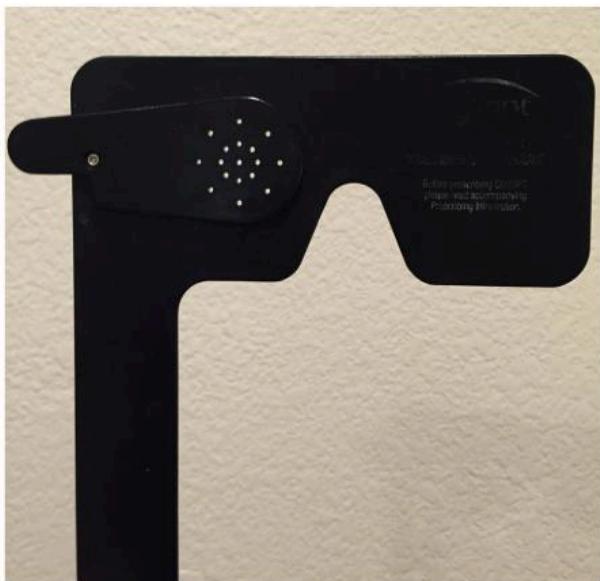
What is the principle of a pinhole?
What is the optimal size of a pinhole and why?
Snellen acuity refers to the standard 20/20 notation of measuring visual acuity and is based on the angle that the smallest letter subtends on the retina. The numerator refers to the testing distance (ie, 20 feet or 6 meters); the denominator represents the distance at which a letter subtends 5 minutes of arc (ie, 20/40 letter subtends 5 minutes at 40 feet, 20/20 letter subtends 5 minutes at 20 feet), or the distance at which a person with normal vision can see the letters. Each stroke width and space subtends 1 minute of arc.
The ETDRS visual acuity measurement was designed to eliminate the inaccuracies of other tests and is considered the gold standard for population studies and clinical research. The ETDRS chart is characterized by a proportional layout and geometric progression of letter sizes. The chart consists of five letters per line, the space between letters is equal to the size of the letters on that line, and the optotype height changes in 0.1 log unit increments.
A pinhole allows only the undeviated paraxial light rays to focus on the retina. It reduces refractive error and improves vision by increasing depth of focus, but it is limited by diffraction. A pinhole can correct for up to 3 D of refractive error and can also improve vision in eyes with corneal or lenticular irregularities. However, a pinhole can reduce vision in eyes with retinal disorders.
The optimal size of a pinhole is 1.2 mm. A smaller hole limits visual acuity because of increased diffraction and reduced amount of light entering the eye.
24

A 47-year-old woman with low myopia complains of trouble reading the newspaper. She wears contact lenses less frequently and has to take off her glasses to read.
What is the problem?
What is the pathogenesis?
Explain the Helmholtz theory of accommodation.
How is accommodation measured?
What is the differential diagnosis of premature presbyopia (subnormal accommodation)?
Explain Donder’s table.
Presbyopia, the natural loss of accommodation with age.
Presbyopia is caused by loss of lens elasticity or possibly reduced ciliary muscle effectivity.
During accommodation, the ciliary muscle contracts (parasympathetic innervation) decreasing zonular tension on the capsule allowing the crystalline lens to become more convex (mainly the anterior surface) and move forward, which increases the focusing power of the eye.
The accommodative response can be described by the amplitude of accommodation (total dioptric amount the eye can accommodate; measured with Prince rule [see Case 3] or method of spheres) or range of accommodation (distance between far point and near point of the eye; measured with tape measure or accommodative rule).
Debilitating illness, head injury, CN3 palsy, Adie tonic pupil, drugs (tranquilizers), diphtheria, botulism, mercury toxicity.
Donder’s table shows the average accommodative amplitudes for different ages.
Up to age 40: accommodation decreases by 1 D every 4 years (starting at 14 D at age 8).
At age 40: accommodation is 6 D (± 2 D).
Between age 40 to 48: accommodation decreases by 1.5 D every 4 years.
After age 48: accommodation decreases by 0.5 D every 4 years.