25

A 34-year-old man reports blurry vision and headaches when working on the computer for more than 20 minutes. He had a prescription for reading glasses in graduate school but never used them. On exam, his uncorrected vision is 20/20 in each eye at distance and J2 at near. Manifest refraction is plano OD and –0.25 sphere OS. His near vision improves to J1+ with +1.25 sphere OU. The rest of the examination is normal.
What is the patient’s problem?
What is asthenopia, and what conditions are associated with it?
What test would be most helpful?
How would you treat the refractive error?
What are the surgical methods for correcting hyperopia?
What is the prevalence and natural history of this condition?
What is the differential diagnosis of acquired hyperopia?
Hyperopia with asthenopia. As the patient ages, he is no longer able to accommodate to fully compensate for all of his hyperopia, and therefore he is experiencing asthenopia.
Asthenopia refers to the symptoms of eye strain (ocular pain, fatigue, headache, blurry vision, light sensitivity) with sustained near effort (from ciliary muscle contraction during accommodation). Most commonly, this is caused by uncorrected presbyopia, pre-presbyopic hyperopia, and overminused myopia. Other etiologies include extraocular muscle imbalance, improper lighting, hypothyroidism, anemia, pregnancy, nutritional deficiencies, and chronic illness.
Refraction. A cycloplegic refraction to reveal the total amount of hyperopia, and later, a careful postcycloplegic refraction pushing plus in a trial frame (to allow the patient to adapt) to determine the prescription that the patient will accept.
In general, hyperopes should be prescribed their full hyperopic correction to provide clear distance and near vision, rather than give only reading glasses, which treats the symptom not the underlying condition. However, older hyperopes who have compensated by accommodating, do not wear glasses, and are nearing presbyopic age may prefer not to wear distance glasses and just wear reading glasses. However, with increasing presbyopia, they will eventually require distance glasses (when they can no longer compensate with accommodation).
LTK, CK, excimer laser (PRK, LASIK), RLE, and phakic IOL (outside United States).
At birth, babies have approximately $+ 3.0$ D of hyperopia, which decreases to approximately $+ 1.0$ D by the age of 2 years. In children, the prevalence of hyperopia ( ≥ + 2.0 D) is inversely associated with age, declining from almost $8.5%$ at the age of $6$ years to approximately $1%$ at $15$ years. The frequency is higher in Caucasians and those living in rural areas. Hyperopia ( ≥ + 0.50 D) prevalence is ∼ 30% in adults and is associated with increasing age (approximately $20%$ in the 5th decade of life and $60%$ after the 8th decade of life).
Decreased effective AL: retrobulbar tumor, choroidal tumor, central serous chorioretinopathy, posterior scleritis, serous retinal detachment.
Decreased refractive power: lens change (posterior lens dislocation, aphakia, diabetes), drugs (chloroquine, phenothiazines, antihistamines, benzodiazepines), poor accommodation (tonic pupil, drugs, trauma), corneal flattening (contact lens, RK surgery), intraocular silicone oil.
26
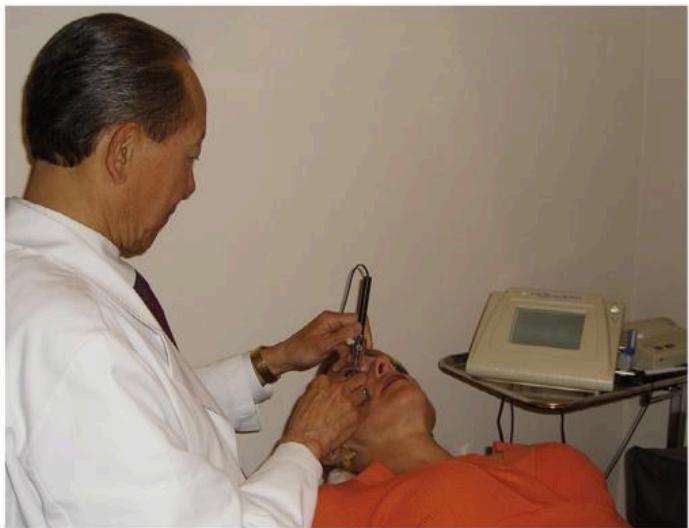
What type of device is depicted, and what does it measure? What alternative method can be used?
What measurements are necessary for calculating IOL power?
How are IOL formulas classified, and what are the advantages of the newer ones?
Why are IOL calculations challenging after keratorefractive surgery?
A-scan ultrasound to measure AL prior to cataract surgery. Partial coherence interferometry (ie, IOLMaster, Lenstar) measures AL and also provides other ocular dimensions and IOL calculations.
Corneal curvature and AL.
First generation: ACD is constant.
Second generation: ACD based on AL.
Third generation: (Holladay 1, Hoffer Q, SRK/T) ACD based on AL and K.
Fourth generation: (Holladay 2) variables include AL, K, corneal diameter, ACD, lens thickness, refraction, and patient age; (Haigis) ELP derived from a function instead of a single number.
Fifth generation: (Olsen, Barrett Universal II) used in IOLMaster and Lenstar devices; (Hoffer H-5) based on Holladay 2 and racial variations.
Other: (Hill-RBF) pattern recognition algorithm; (Ladas super formula) amalgam of existing formulas.
The newer formulas are more accurate. Most accurate third and fourth generation formulas according to AL:
Short eyes (<22.0 mm): Hoffer Q and Holladay II
Medium eyes (22.0–24.5 mm): Hoffer Q, Holladay I or 2, SRK/T, Haigis
Medium-long eyes (24.5–26.5 mm): Holladay 1 or 2
Long eyes (>26.5 mm): SRK/T, Holladay 2, Haigis
The Wang-Koch adjustment formulas improve the accuracy in eyes with AL ≥ 25.2 m m.
Corneal refractive surgery changes the anterior corneal curvature in a nonuniform way. This causes less accurate measurements with traditional methods of keratometry, which results in less predictable IOL calculations and refractive outcomes. Correction formulas and intraoperative wavefront aberrometry are helpful for achieving better results.
Дальше — с подпиской Awamed+
Осталось ещё 323 страницы источника. Подписка открывает материал целиком вместе с оригиналом, рисунками и файлами.