12
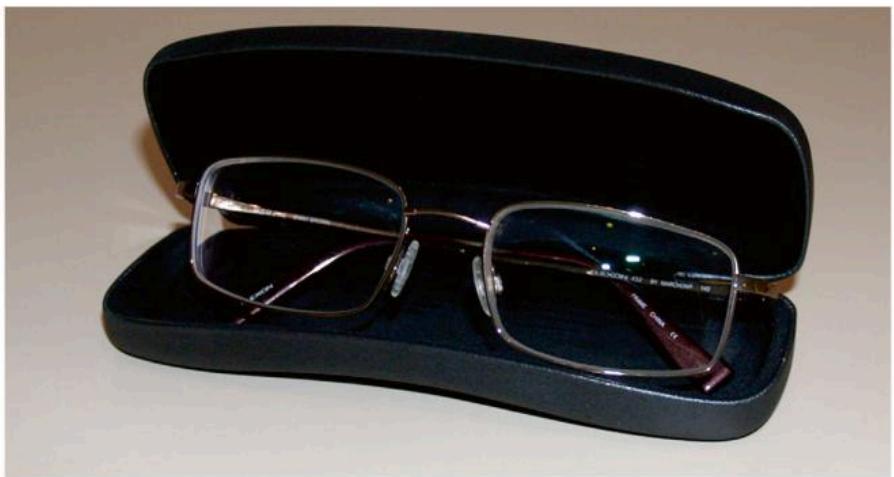
An angry patient walks into your office complaining that the new distance glasses you prescribed are terrible. He has tried them for 2 weeks and cannot get used to them. The glasses make him feel sick. There was only a minor change (0.25 D) in the prescription compared with his old glasses.
What do you do?
Additional information: the glasses were made correctly; he says his vision is clear when he looks straight ahead, but everything seems more magnified and his vision is distorted when he looks to the sides; he cannot do anything to make it better. The PD is right, the optical centers are placed correctly, and repeat refraction is the same as the prescription you recently gave him.
What else should you check and how?
It is important to explain to the patient that there are a number of reasons why he may be having difficulty with the glasses and you will take care of the problem. First, the glasses should be measured with a lensometer to determine whether they were made correctly. If they were, the patient should be questioned about his symptoms: is the vision clear or blurry, is there any distortion, is the difficulty in one eye or both eyes? Can he make it better by adjusting the glasses or moving or turning his eyes or head? Check the ocular alignment of the lenses and repeat the manifest refraction.
The base curve of the lenses should be checked with a Geneva lens clock because a change in base curve can cause these symptoms (distortion and the feeling of motion sickness when looking off-center). Increasing the base curve also results in thicker lenses, and more magnification occurs.
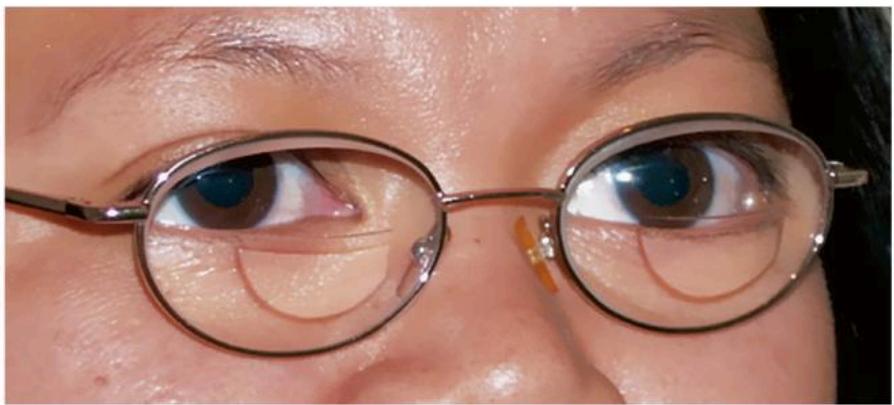
A 16-year-old aphakic girl is interested in wearing contact lenses instead of aphakic glasses. Her manifest refraction is +10.50 + 1.00 × 90 OD and +11.25 + 0.50 × 90 OS.
What are the disadvantages of aphakic spectacles?
What would the image magnification be with a contact lens, and with an IOL?
What are her contact lens options?
Would the power of the contact lenses she requires be stronger or weaker than her glasses prescription? Why?
The disadvantages of aphakic glasses are: image magnification of 25%, altered depth perception, pincushion distortion, ring scotoma (prismatic effect at edge of lens causes visual field loss of 20%), and the “jack-in-the-box” phenomenon (peripherally invisible objects suddenly appear when gaze is shifted).
There would be 7% image magnification with contact lens and 2.5% with IOL.
She could wear soft lenses (spherical OU or possibly a toric lens OD for sharper vision) or RGP lenses OU (which will provide sharper vision by correcting her astigmatism).
Because of the difference in vertex distance between glasses and contact lens, the power of the required correcting lens is different. The effectivity of a plus lens increases as it moves further from the eye (greater plus power), whereas the lens effectivity of a minus lens increases as it moves closer to the eye. The more powerful the lens, the more significant is the change in position. As any lens moves closer to the nodal point of the eye, more plus power is required to keep the image focused onto the retina. Therefore, the contact lens this patient needs has more plus power than her glasses lens. The power is determined from:
Focal point of original lens = far point.
Distance of new lens from far point = required focal length of new lens.
Power of new lens = reciprocal of new focal length.
This can be approximated with the formula: D2 = D1 + S(D1)2 (where S = vertex distance in meters).
14

A 76-year-old woman with macular degeneration reports more difficulty with her vision over the past few months. She used to be able to read large print books with bright light but is struggling to do so now, so she wants to get new reading glasses. Her visual acuity is 20/400 OD and 20/80 OS. She denies any change in appearance of the Amsler grid, which she checks several times a week OS. Exam of the maculas shows a disciform scar OD and drusen with RPE atrophy OS.
How would you estimate the add power for reading glasses?
What type of low-vision aids would be helpful for this patient?
Kestenbaum’s rule can be used to estimate the strength of the plus lens required to read newspaper print without accommodation. This is useful in patients with low vision. The necessary add power is the reciprocal of the best distance acuity. This patient has no central vision OD and uses her left eye for reading. Therefore, she would need a reading add of +4.00 D (ie, 80/20) for a working distance of 0.25 m (the reciprocal of the add power). This should be checked and refined with trial frames or a phoropter.
If the new reading glasses are not sufficient, then other options include spectacle-mounted magnifiers (telescopes for distance or microscopes for near), handheld or stand magnifiers and telescopes, video magnifiers (CCTVs), electronic reading machines, and talking appliances. The patient may benefit from a low-vision consultation to assess her visual needs and try various aids to determine what works best for her.
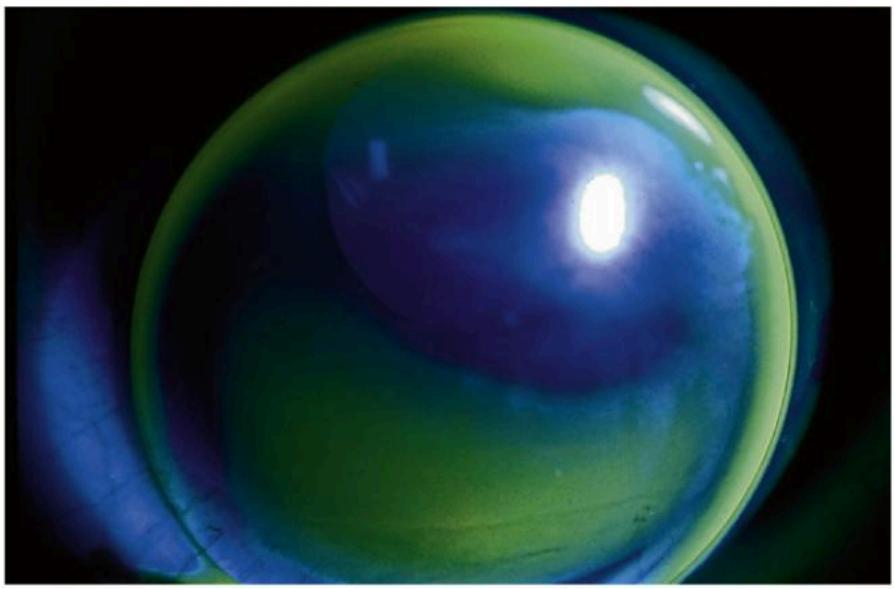
A 53-year-old woman is unhappy with her current contact lenses and wants to be fitted for new lenses.
What is the technique for fitting RGP contact lens?
What is the technique for fitting SCL?
The RGP lens rides high; how can the lens parameters be changed to improve the fit?
RGPs are fitted using the “steeper add minus, flatter add plus” (SAM-FAP) rule. The contact lens is fitted steeper than the average corneal keratometry measurement. This forms a plus tear meniscus between the cornea and RGP lens, which alters the required power of the lens. Therefore, it is necessary to subtract power (add minus) at the end of the power calculation. For each diopter the base curve is made steeper than K, subtract 1 D from the final lens power. If the lens is fit flatter than K, then a minus tear meniscus is formed, so it is necessary to add plus power at the end of the calculation. A contact lens overrefraction is performed to determine the necessary power. If a trial lens is not available for overrefraction, then the power calculation is performed as follows: