4

A 31-year-old woman with a refractive error of 2.50 D in both eyes is interested in refractive surgery. She has become contact lens intolerant and glasses interfere with her sports activities and lifestyle.
What would you tell her about surgical correction of her myopia?
What are the complications of LASIK?
Additional information: this patient undergoes LASIK. The day after surgery, she is very happy with her 20/20 vision. On exam, her left eye has the finding seen in the photo.
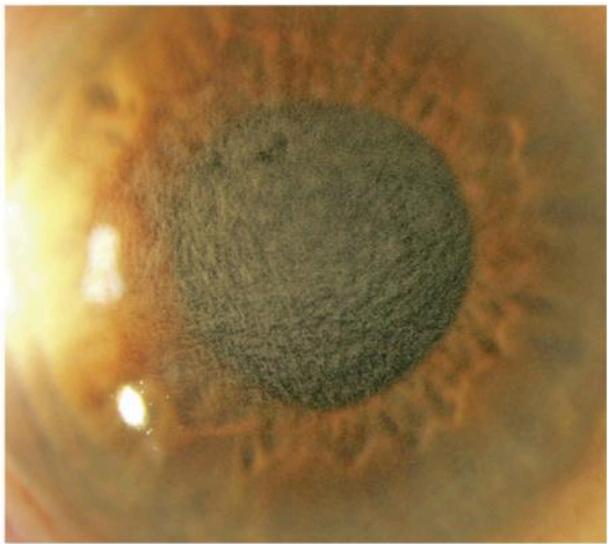
What is the diagnosis and how is it classified?
How would you treat this?
There are a number of surgical options for correcting low myopia. The most common is excisional (laser vision correction [surface ablation, LASIK, SMILE]). Other techniques include incisional (RK) and additive (implants [Intacs]). The indications, risks, benefits, alternatives, and complications of surgery should be discussed as well as the advantages and disadvantages of each of the procedures. She should also be told about what to expect during the preoperative and postoperative periods.
LASIK complications include: over- or undercorrection, glare/halos at night, dry eye, irregular/poor flap (too thick or thin, button-hole, incomplete, free cap), epithelial defect, decentered ablation, irregular astigmatism, flap dislocation, striae, epithelial ingrowth, interface inflammation (DLK), central toxic keratopathy, infection, scarring, and keratectasia. Late DLK may occur (any time in the future) after a corneal abrasion.
DLK, stage 2. Classification is as follows:
Stage 1: peripheral inflammatory cells (usually postop day 1–2).
Stage 2: inflammatory cells migrate centrally (usually postop day 3–4).
Stage 3: more central inflammatory cells with scarring.
Stage 4: stomal melting and scarring.
Frequent topical steroids. Steroid eye drops should be prescribed initially every hour while awake and steroid ointment at bedtime. The eye should be checked daily for improvement, and the steroids are tapered as the DLK resolves. If the interface inflammation progresses to stage 3 or 4, then the flap should be lifted and the stromal bed irrigated. A short course of oral steroids may also be given.
5
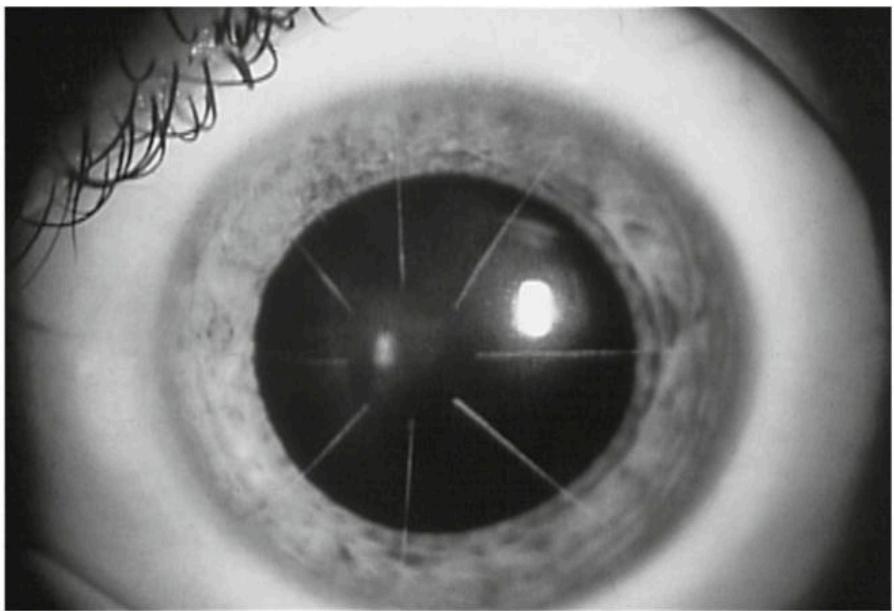
A 50-year-old man reports a history of RK surgery 20 years ago. He has noted glare and starbursts at night since the surgery. He used to experience fluctuating vision but says this has improved. He also notes that his vision has gradually deteriorated, especially over the last 10 years, and he needs stronger glasses for better reading as well as distance vision.
What would you specifically look for on exam?
What would you tell him about his symptoms?
What are the treatment options?
Manifest refraction, pupil size in dim and bright light, the corneal status (number of RK incisions and optical zone size, central irregularity, scarring, dryness), presence of cataract, and macular pathology. If there is visual fluctuation throughout the day, then morning and afternoon refractions should be performed.
Glare/starbursts are common after RK, particularly with smaller optical zones. The deep radial corneal incisions change the shape of the cornea but also weaken the cornea and can produce fluctuations in vision throughout the day and from day to day as refractive shifts occur. Altitude and humidity changes can exacerbate the fluctuations. Over time, many RK patients develop a progressive hyperopic shift (PERK study 10-year results found 43% of patients had at least a 1 D shift). In addition, this patient is presbyopic and is noting the combined effect of progressive hyperopia from the RK plus increasing presbyopia.
Treatment options include correction of any refractive error and pharmacologic (alphagan or pilocarpine) to reduce pupil size and decrease nighttime glare/starburst. He may need different glasses for different times of the day depending on the amount of fluctuation. If the refractive error is stable, then surface ablation can be performed with topical mitomycin C (to prevent scarring). If his symptoms are due to a cataract, then cataract surgery should be discussed and the patient informed that the refractive outcome is less predictable because of his previous RK surgery (eg, accurately measuring central corneal power), and therefore he may require a second procedure (laser vision correction, piggyback IOL, or IOL exchange) to correct a significant residual refractive error.
6
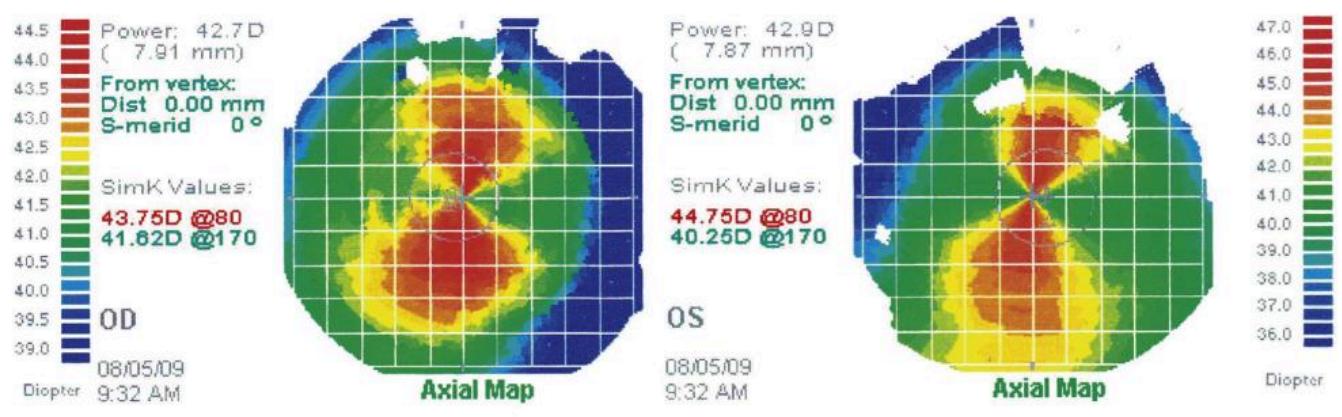
A patient with astigmatism complains of problems adapting to her new glasses and says she can see better with her old glasses. Her old prescription is - 5.00 + 2.00 × 85OD and - 6.50 + 3.50 × 85OS; her new prescription is - 5.25 + 2.25 × 95OD and - 7.50 + 4.25 × 80OS.
How would you address her complaint?
What does the corneal topography show?
What is the typical natural history of corneal astigmatism?
How is astigmatism corrected surgically?
The new glasses should be measured with a lensometer to confirm that the prescription is correct, the ocular alignment of the lenses checked, and the visual acuity recorded. The manifest refraction should then be rechecked carefully, and consider performing a cycloplegic refraction. If there is an error in the glasses or lens alignment, then simply remaking the lenses may resolve the problem. If the repeat manifest or cycloplegic refraction is different from the glasses prescription, then a new prescription should be given to the patient. Finally, patients with large levels of correction are particularly sensitive to small changes in their glasses prescription (ie, >0.50 D and/or >5 degrees axis rotation), and the vertex distance and base curve of the lenses must also be taken into account. Therefore, it may be necessary to make only a small change in the prescription at a time until the full change can be tolerated. When there is a significant change in the prescription, the patient should be told of this and warned that it may take some time to adapt to the new glasses.