X
XT - exotropia
1
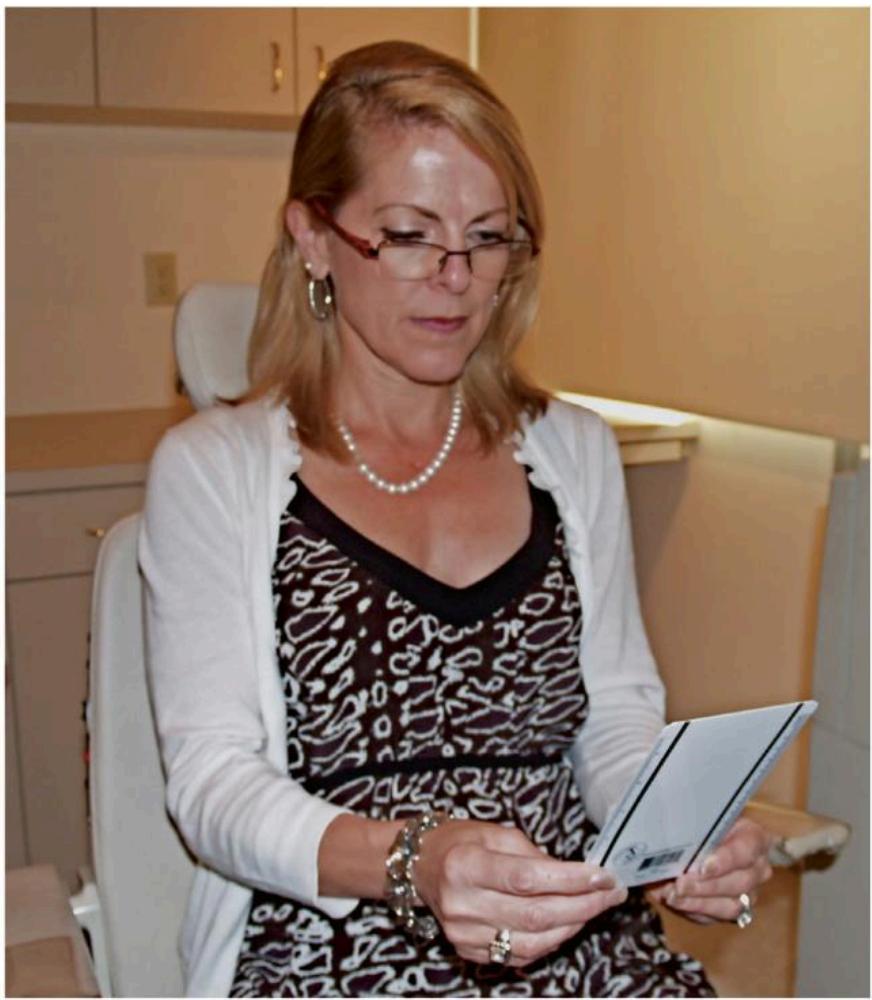
A 48-year-old woman with myopia complains of progressive deterioration in distance and near vision in both eyes for the past 2 years. She can improve her vision by sliding her glasses down her nose. Her past medical history is significant for diabetes for 10 years, for which she takes glyburide. She reports blood sugar levels usually between 120 and 140 mg/dL and a recent hemoglobin A1c of 6.8%.
What is the differential diagnosis?
What other history would you like to know?
What would your exam entail?
Additional information: her current glasses are –5.00 D with an add of +1.25 D OU, her manifest refraction is –4.25 D OD and –4.50 D OS with +1.50 D add OU. The crystalline lenses are clear OU and there is no diabetic retinopathy. Cycloplegic refraction reveals –4.25 D OU.
What is your diagnosis and treatment plan?
Decreased myopia and increased presbyopia. The change in refractive error may be due to overcorrection in her current distance spectacle prescription, cataracts, diabetic macular edema, or medications (ie, chloroquine, phenothiazines, antihistamines, benzodiazepines).
How old is her current prescription and what type of glasses are they? Does she have glare/halo/starburst from lights? Has the diabetes ever affected her retina and if so did she ever have any retinal treatment? Is she taking any other medications?
Measure her current glass prescription, perform a manifest refraction, and then a complete eye exam with attention to the crystalline lens for cataract and retina for diabetic macular edema.
Myopia/presbyopia with overminused glasses. A new glasses prescription should be given using the power from her manifest refraction. She should continue good blood sugar control and return for annual eye exams.
2
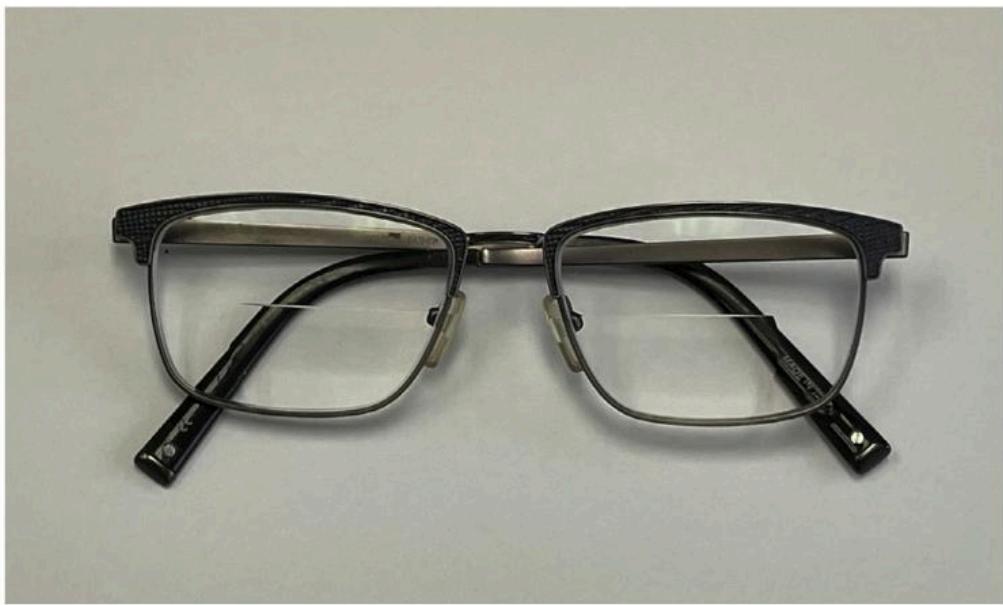
A 50-year-old man notices more difficulty reading and working on the computer. He uses his wife’s “cheaters,” which help.
What are his spectacle options?
What are the two prismatic effects that occur with bifocals?
Discuss the advantages and disadvantages of different bifocal designs.
What are the alternatives to glasses for correcting presbyopia?
The glasses options are progressive, bifocal, or single vision lenses. Glasses for the computer can be single vision, trifocal, or computer bifocals.
Image jump and image displacement.
Image jump is related to the position of the optical center of the add segment. It is produced by the sudden prismatic power at the top of the bifocal segment (it is not influenced by the type of underlying lens). As the patient’s line of sight crosses from the optical center of the distance lens to the bifocal segment, the image position suddenly shifts up owing to the base-down prismatic effect of the bifocal segment.
Image displacement is due to the total prismatic power of the lens and bifocal segment. It is minimized when the prismatic effect of the bifocal segment and distance lens are in opposite directions.
Image jump is more bothersome than image displacement, so the segment type should be chosen to minimize image jump.
The advantage of progressive lenses is the blended segment without a visible line and there is no image jump; however, there is usually an adaptation period, especially for patients who have previously worn lined bifocals.
Bifocal lenses have a visible line and there are different types of segment styles – round-top, flat-top, and executive. Round-top segments produce the most image jump, and they cause more image displacement in myopes than in hyperopes. Flat-top segments minimize image jump, and image displacement is less in a myope than in a hyperope. Executive bifocals have a larger area dedicated to near vision, and there is no image jump because the optical centers are at the top of the segment.
Contact lenses: monovision or bifocal/multifocal lenses.
Medication: topical miotic eyedrops to constrict pupil and increase depth of field.
Surgery: laser vision correction (monovision or presbyopic ablation [outside United States], corneal inlay (nondominant eye), scleral procedure (incisions, laser, implants), RLE monovision or bifocal/multifocal/ accommodating IOL.
3
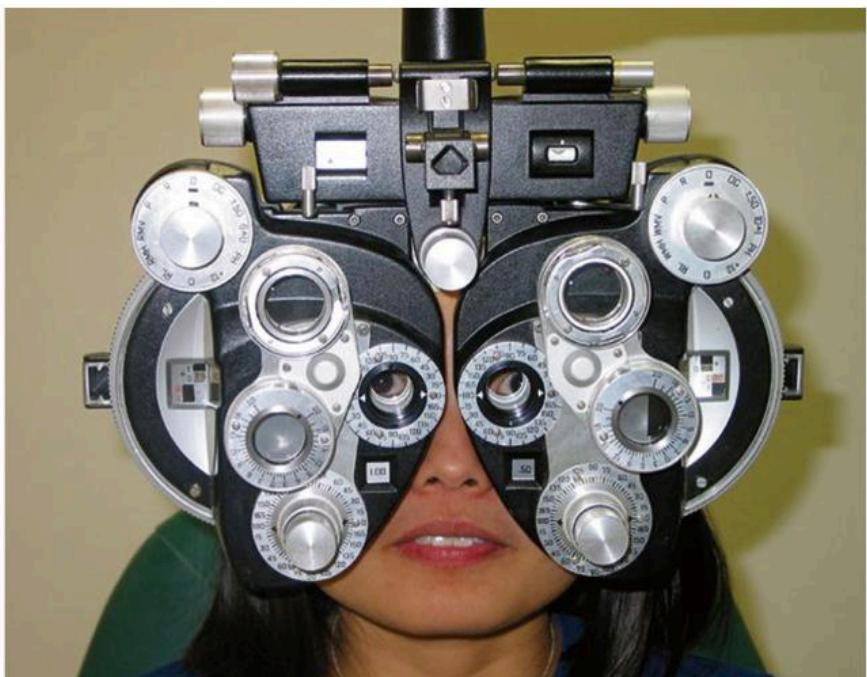
A 46-year-old woman complains of trouble with near vision. Her current glasses are 4 years old and she says her eyes feel strained when she reads. She wants to get a new prescription for glasses.
What is the technique for subjective manifest refraction?
How would you determine her add power?
Starting with her current prescription in either a trial lens or phoropter, the distance vision is checked monocularly and the sphere is adjusted first as she is asked to read progressively smaller lines on the acuity chart. The axis of any cylinder is then refined with a Jackson cross cylinder. The vision must be at least 20/40 to use the 0.25 cross cylinder. Once the correct axis is determined, the amount of cylinder is then determined in a similar fashion with the cross cylinder. The sphere is then rechecked until the best acuity is achieved. Finally, three methods can be used to perform binocular balance to equally control accommodation in both eyes during distance refraction: prism dissociation (3 PD base-up over one eye and 3 PD base-down over the other with a Risley prism), balanced fogging (fog both eyes and alternate cover until equally fogged), or duochrome test (red–green balance both eyes).
To determine the bifocal add, measure accommodation monocularly then binocularly. A Prince rule (reading card with a ruler calibrated in centimeters and diopters to measure amplitude of accommodation) can be used with the phoropter to determine the necessary accommodative requirement for various near vision tasks. Half of the patient’s measured accommodative amplitude should be held in reserve to prevent asthenopia.
For example, if the patient desires to read at 40 cm (2.5 D), the Prince rule measures 2.0 D of amplitude (1.0 D is available to patient to prevent asthenopic symptoms), then the add power is 1.5 D (the difference between accommodation [1.0 D] and the total amount of accommodation required to read [2.5 D]). With the calculated add in front of the distance correction, measure the accommodative range (near point to far point of accommodation). If the range is too close, then reduce the add in steps of 0.25 D until the correct range is found.