Arun D. Singh Bertil E. Damato Editors
Clinical Ophthalmic Oncology
Basic Principles
Fourth Edition
Clinical Ophthalmic Oncology
Arun D. Singh • Bertil E. Damato
Editors
Clinical Ophthalmic Oncology
Basic Principles
Fourth Edition
Editors
Arun D. Singh
Department of Ophthalmic Oncology
Cole Eye Institute, Cleveland Clinic https://doi.org/10.1007/978-3-031-75907-9
Cleveland, OH, USA
Bertil E. Damato
Ocular Oncology Service
Moorfields Eye Hospital
London, UK
ISBN 978-3-031-75906-2
ISBN 978-3-031-75906-2 ISBN 978-3-031-75907-9 (eBook)
$\textcircled{c}$ The Editor(s) (if applicable) and The Author(s), under exclusive license to Springer Nature Switzerland AG 2015, 2019, 2025
This work is subject to copyright. All rights are solely and exclusively licensed by the Publisher, whether the whole or part of the material is concerned, specifically the rights of translation, reprinting, reuse of illustrations, recitation, broadcasting, reproduction on microfilms or in any other physical way, and transmission or information storage and retrieval, electronic adaptation, computer software, or by similar or dissimilar methodology now known or hereafter developed.
The use of general descriptive names, registered names, trademarks, service marks, etc. in this publication does not imply, even in the absence of a specific statement, that such names are exempt from the relevant protective laws and regulations and therefore free for general use.
The publisher, the authors and the editors are safe to assume that the advice and information in this book are believed to be true and accurate at the date of publication. Neither the publisher nor the authors or the editors give a warranty, expressed or implied, with respect to the material contained herein or for any errors or omissions that may have been made. The publisher remains neutral with regard to jurisdictional claims in published maps and institutional affiliations.
This Springer imprint is published by the registered company Springer Nature Switzerland AG
The registered company address is: Gewerbestrasse 11, 6330 Cham, Switzerland
If disposing of this product, please recycle the paper.
Principles of Cancer Epidemiology
Annette C. Moll, Michiel R. de Boer, Lex M. Bouter, and Nakul Singh
1.1 Introduction
During the last decade, evidence-based medicine (EBM) has become a dominant approach in many medical fields, including ophthalmology [1, 2]. Clinical epidemiological studies provide evidence that can aid decision-making processes. An overwhelming amount of clinical epidemiological papers are being published every year, and critical appraisal of the findings can be challenging, especially for the busy clinician who is not formally trained in the field of clinical epidemiology. Therefore, the available evidence is increasingly bundled in clinical guidelines. The aim of this chapter is to provide readers with some basic knowledge to allow them to judge the value of clinical epidemiological papers and, thus, the pillars of evidence-based clinical guidelines. Examples from ocular oncology will be used to illustrate the methodological principles.
1.2 Research Question
A clinical epidemiological study should always start with a well-defined research question. Similarly, when reading a paper, one should always first identify the question(s) the authors wish to address (Fig. 1.1). Research questions can be aimed at explanation or description. Explanatory research examines causal relationships, while descriptive research is merely descriptive. In addition, research questions are also often categorized as etiological, diagnostic, or prognostic (Table 1.1). For example, an explanatory research question related to etiology in the field of ocular oncology is as follows: are children born after in vitro fertilization at higher risk of developing retinoblastoma as compared to children born after natural conception? [3] A correct explanatory research question should contain information on the patients, interventions, contrast, and outcomes (PICO) at issue.
A. C. Moll ( $\boxtimes$) Department of Ophthalmology, VU University Medical Center, Amsterdam, The Netherlands e-mail: a.moll@vumc.nl
M. R. de Boer Department of Health Sciences, VU Amsterdam, Amsterdam, The Netherlands
L. M. Bouter Department of Epidemiology and Biostatistics, VU University Medical Centre, Amsterdam, The Netherlands
N. Singh School of Medicine, Case Western University, Cleveland, OH, USA
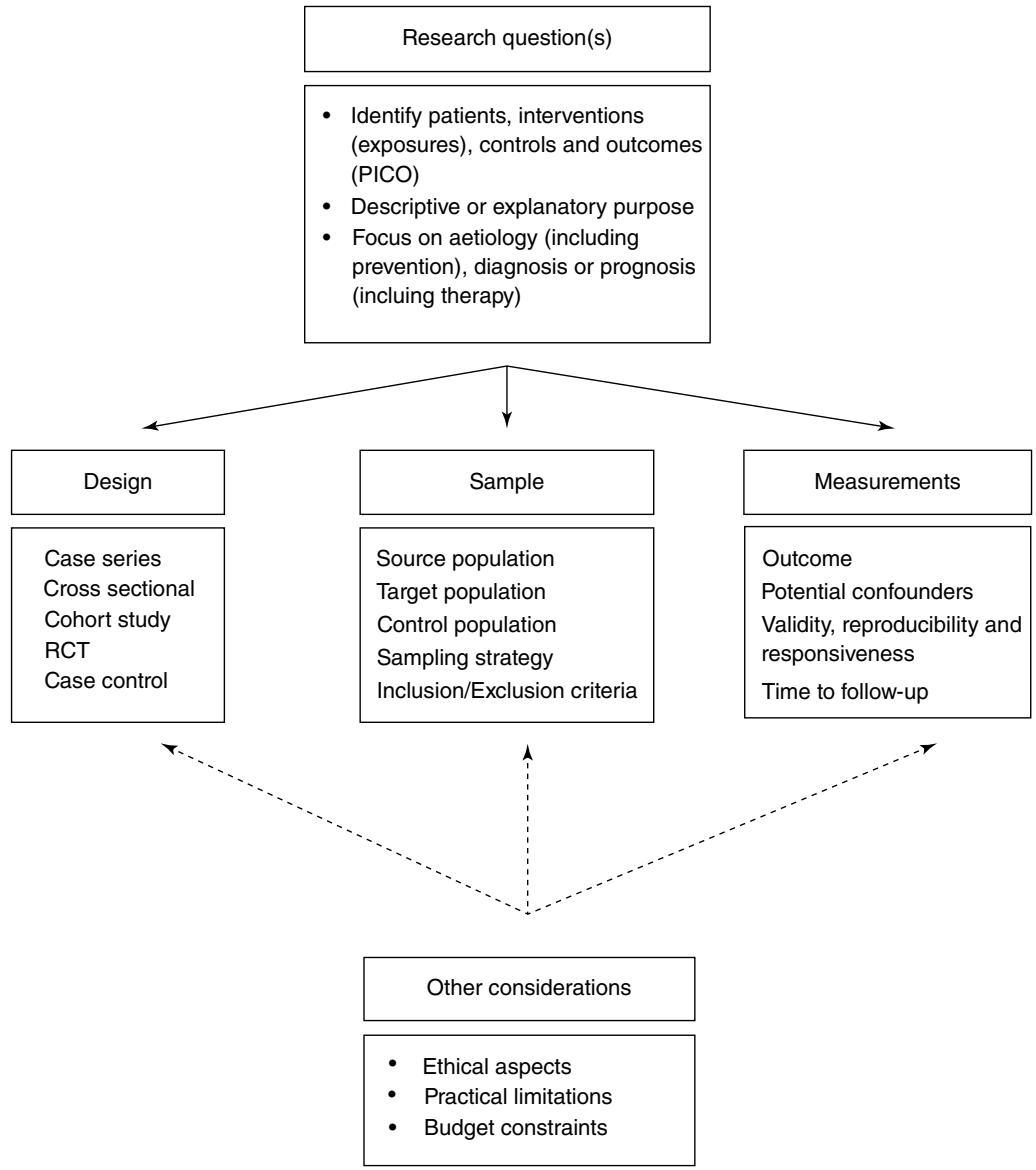
Fig. 1.1 Steps in designing a clinical epidemiological research
Table 1.1 Types of epidemiological research
| Type of research | Purpose | Example |
| Etiology (including prevention) | To examine possible etiological factors for the occurrence of a disease | Association between ultraviolet radiation and uveal melanoma |
| Diagnosis | To examine the usefulness of diagnostic tests for the disease | Accuracy of magnetic resonance imaging in determining choroidal invasion of retinoblastoma |
| Prognosis (including interventions) | To examine possible prognostic factors for the disease | Association between external beam therapy for retinoblastoma and the incidence of second malignant neoplasms |