Arun D. Singh, Bertil E. Damato, редакторы
Arun D. Singh Bertil E. Damato Editors
Клиническая офтальмоонкология
Clinical Ophthalmic Oncology
Основные принципы
Basic Principles
Четвертое издание
Fourth Edition
Клиническая офтальмоонкология
Clinical Ophthalmic Oncology
Arun D. Singh • Bertil E. Damato
Arun D. Singh • Bertil E. Damato
Редакторы
Editors
Клиническая офтальмоонкология
Clinical Ophthalmic Oncology
Основные принципы
Basic Principles
Четвертое издание
Fourth Edition
Редакторы
Editors
Arun D. Singh
Arun D. Singh
Отделение офтальмоонкологии
Department of Ophthalmic Oncology
Cole Eye Institute, Cleveland Clinic https://doi.org/10.1007/978-3-031-75907-9
Cole Eye Institute, Cleveland Clinic https://doi.org/10.1007/978-3-031-75907-9
Кливленд, OH, США
Cleveland, OH, USA
Bertil E. Damato
Bertil E. Damato
Служба окулярной онкологии
Ocular Oncology Service
Moorfields Eye Hospital
Moorfields Eye Hospital
Лондон, Великобритания
London, UK
ISBN 978-3-031-75906-2
ISBN 978-3-031-75906-2 ISBN 978-3-031-75907-9 (электронная книга)
ISBN 978-3-031-75906-2 ISBN 978-3-031-75907-9 (eBook)
$\textcircled{c}$ Редактор(ы) (если применимо) и Автор(ы) под исключительной лицензией Springer Nature Switzerland AG 2015, 2019, 2025
$\textcircled{c}$ The Editor(s) (if applicable) and The Author(s), under exclusive license to Springer Nature Switzerland AG 2015, 2019, 2025
Данная работа является объектом авторского права. Все права принадлежат исключительно Издателю, независимо от того, касается ли это всего материала или его части, в частности прав на перевод, перепечатку, повторное использование иллюстраций, чтение, вещание, воспроизведение на микрофильмах или любым другим физическим способом, а также передачу или хранение и поиск информации, электронную адаптацию, компьютерное программное обеспечение или с помощью аналогичной или отличной методологии, известной в настоящее время или разработанной в будущем.
This work is subject to copyright. All rights are solely and exclusively licensed by the Publisher, whether the whole or part of the material is concerned, specifically the rights of translation, reprinting, reuse of illustrations, recitation, broadcasting, reproduction on microfilms or in any other physical way, and transmission or information storage and retrieval, electronic adaptation, computer software, or by similar or dissimilar methodology now known or hereafter developed.
Использование в данной публикации общих описательных названий, зарегистрированных названий, товарных знаков, знаков обслуживания и т. д. не подразумевает, даже при отсутствии специального заявления, что такие названия освобождены от соответствующих защитных законов и правил и, следовательно, свободны для общего использования.
The use of general descriptive names, registered names, trademarks, service marks, etc. in this publication does not imply, even in the absence of a specific statement, that such names are exempt from the relevant protective laws and regulations and therefore free for general use.
Издатель, авторы и редакторы могут полагать, что советы и информация в этой книге считаются истинными и точными на дату публикации. Ни издатель, ни авторы, ни редакторы не дают никаких гарантий, явных или подразумеваемых, в отношении содержащегося здесь материала или в отношении любых ошибок или пропусков, которые могли быть допущены. Издатель сохраняет нейтралитет в отношении юрисдикционных претензий в опубликованных картах и институциональной принадлежности.
The publisher, the authors and the editors are safe to assume that the advice and information in this book are believed to be true and accurate at the date of publication. Neither the publisher nor the authors or the editors give a warranty, expressed or implied, with respect to the material contained herein or for any errors or omissions that may have been made. The publisher remains neutral with regard to jurisdictional claims in published maps and institutional affiliations.
Данное издание Springer выпущено зарегистрированной компанией Springer Nature Switzerland AG
This Springer imprint is published by the registered company Springer Nature Switzerland AG
Адрес зарегистрированной компании: Gewerbestrasse 11, 6330 Cham, Switzerland
The registered company address is: Gewerbestrasse 11, 6330 Cham, Switzerland
При утилизации данного продукта, пожалуйста, перерабатывайте бумагу.
If disposing of this product, please recycle the paper.
Принципы эпидемиологии рака
Principles of Cancer Epidemiology
Annette C. Moll, Michiel R. de Boer, Lex M. Bouter, and Nakul Singh
Annette C. Moll, Michiel R. de Boer, Lex M. Bouter, and Nakul Singh
1.1 Введение
1.1 Introduction
В течение последнего десятилетия доказательная медицина (EBM) стала доминирующим подходом во многих областях медицины, включая офтальмологию [1, 2]. Клинические эпидемиологические исследования предоставляют доказательства, которые могут помочь в процессах принятия решений. Ежегодно публикуется огромное количество клинических эпидемиологических работ, и критическая оценка результатов может быть сложной задачей, особенно для занятого клинициста, который не прошел формальную подготовку в области клинической эпидемиологии. Поэтому имеющиеся доказательства все чаще объединяются в клинические рекомендации. Цель данной главы — предоставить читателям базовые знания, которые позволят им оценивать ценность клинических эпидемиологических работ и, следовательно, основ клинических рекомендаций, основанных на доказательствах. Для иллюстрации методологических принципов будут использованы примеры из области глазной онкологии.
During the last decade, evidence-based medicine (EBM) has become a dominant approach in many medical fields, including ophthalmology [1, 2]. Clinical epidemiological studies provide evidence that can aid decision-making processes. An overwhelming amount of clinical epidemiological papers are being published every year, and critical appraisal of the findings can be challenging, especially for the busy clinician who is not formally trained in the field of clinical epidemiology. Therefore, the available evidence is increasingly bundled in clinical guidelines. The aim of this chapter is to provide readers with some basic knowledge to allow them to judge the value of clinical epidemiological papers and, thus, the pillars of evidence-based clinical guidelines. Examples from ocular oncology will be used to illustrate the methodological principles.
1.2 Исследовательский вопрос
1.2 Research Question
Клиническое эпидемиологическое исследование всегда должно начинаться с четко определенного исследовательского вопроса. Аналогично, при чтении статьи следует сначала определить вопрос(ы), на которые авторы хотят ответить (Рис. 1.1). Исследовательские вопросы могут быть направлены на объяснение или описание. Объяснительные исследования изучают причинно-следственные связи, в то время как описательные исследования являются чисто описательными. Кроме того, исследовательские вопросы часто классифицируются как этиологические, диагностические или прогностические (Таблица 1.1). Например, объяснительный исследовательский вопрос, связанный с этиологией в области глазной онкологии, звучит следующим образом: имеют ли дети, рожденные после экстракорпорального оплодотворения, более высокий риск развития ретинобластомы по сравнению с детьми, рожденными в результате естественного зачатия? [3] Правильный объяснительный исследовательский вопрос должен содержать информацию о пациентах, вмешательствах, контрольной группе и исходах (PICO), которые рассматриваются.
A clinical epidemiological study should always start with a well-defined research question. Similarly, when reading a paper, one should always first identify the question(s) the authors wish to address (Fig. 1.1). Research questions can be aimed at explanation or description. Explanatory research examines causal relationships, while descriptive research is merely descriptive. In addition, research questions are also often categorized as etiological, diagnostic, or prognostic (Table 1.1). For example, an explanatory research question related to etiology in the field of ocular oncology is as follows: are children born after in vitro fertilization at higher risk of developing retinoblastoma as compared to children born after natural conception? [3] A correct explanatory research question should contain information on the patients, interventions, contrast, and outcomes (PICO) at issue.
A. C. Moll ( $\boxtimes$) Department of Ophthalmology, VU University Medical Center, Amsterdam, The Netherlands e-mail: a.moll@vumc.nl
A. C. Moll ( $\boxtimes$) Department of Ophthalmology, VU University Medical Center, Amsterdam, The Netherlands e-mail: a.moll@vumc.nl
M. R. de Boer Department of Health Sciences, VU Amsterdam, Amsterdam, The Netherlands
M. R. de Boer Department of Health Sciences, VU Amsterdam, Amsterdam, The Netherlands
L. M. Bouter Department of Epidemiology and Biostatistics, VU University Medical Centre, Amsterdam, The Netherlands
L. M. Bouter Department of Epidemiology and Biostatistics, VU University Medical Centre, Amsterdam, The Netherlands
N. Singh School of Medicine, Case Western University, Cleveland, OH, USA
N. Singh School of Medicine, Case Western University, Cleveland, OH, USA
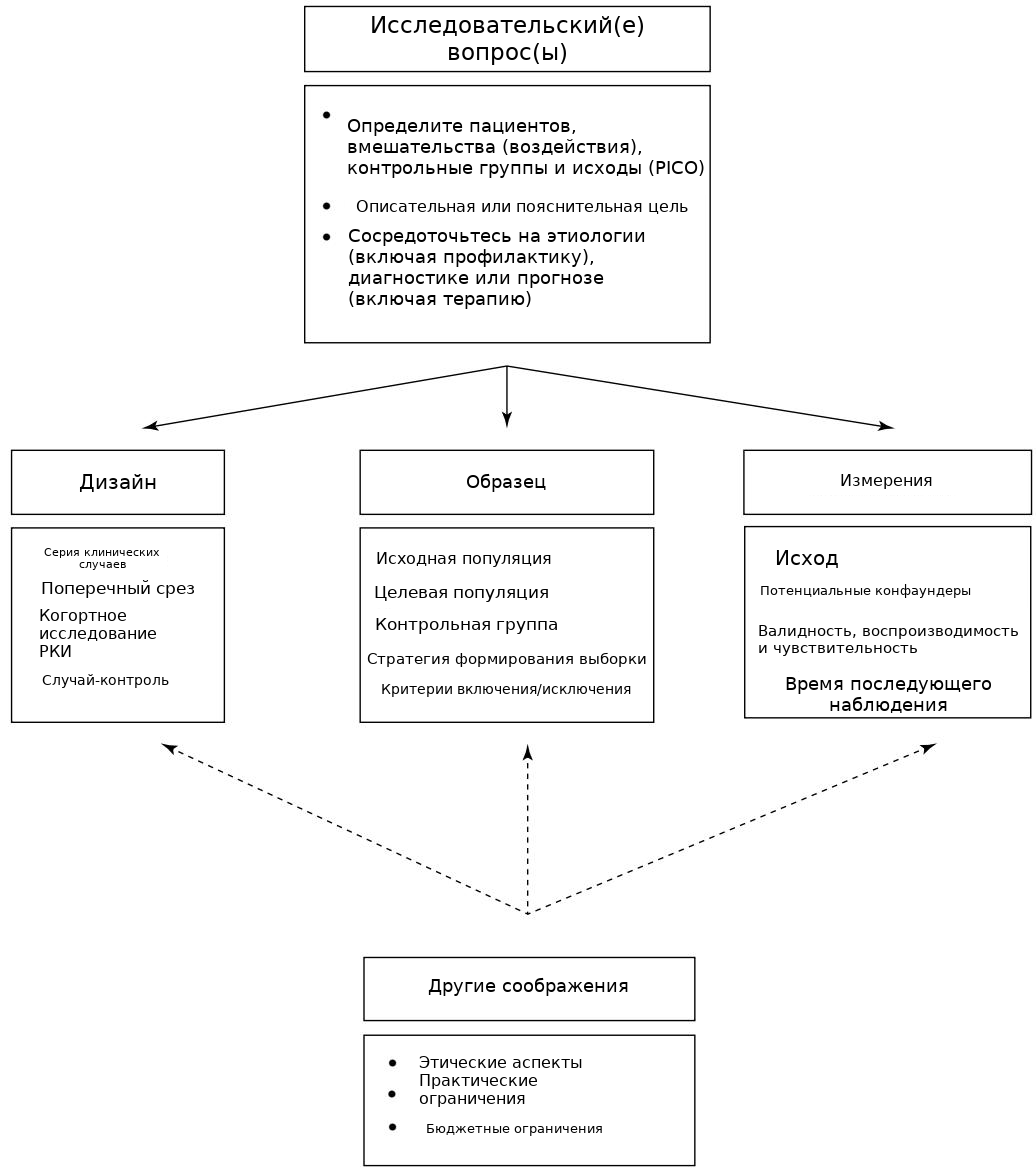
Рис. 1.1 Этапы планирования клинического эпидемиологического исследования
Fig. 1.1 Steps in designing a clinical epidemiological research
Таблица 1.1 Типы эпидемиологических исследований
Table 1.1 Types of epidemiological research
| Тип исследования | Цель | Пример |
| Этиология (включая профилактику) | Изучение возможных этиологических факторов возникновения заболевания | Связь между ультрафиолетовым излучением и увеальной меланомой |
| Диагностика | Изучение полезности диагностических тестов для заболевания | Точность магнитно-резонансной томографии в определении хориоидальной инвазии ретинобластомы |
| Прогноз (включая вмешательства) | Изучение возможных прогностических факторов заболевания | Связь между лучевой терапией при ретинобластоме и частотой возникновения вторичных злокачественных новообразований |
| Type of research | Purpose | Example |
| Etiology (including prevention) | To examine possible etiological factors for the occurrence of a disease | Association between ultraviolet radiation and uveal melanoma |
| Diagnosis | To examine the usefulness of diagnostic tests for the disease | Accuracy of magnetic resonance imaging in determining choroidal invasion of retinoblastoma |
| Prognosis (including interventions) | To examine possible prognostic factors for the disease | Association between external beam therapy for retinoblastoma and the incidence of second malignant neoplasms |